Back
Back
Published 2026.05.05
Family photo!
Before I begin, I have to offer this disclaimer: today's blog post is, obviously, about watches. Some of my regular readers may be taken aback by this one's dryness and the volume of enthusiast jargon found therein. I do hope that those outside the watch-collecting hobby can find something of interest here, but if not, I promise I'll write about something else soon.
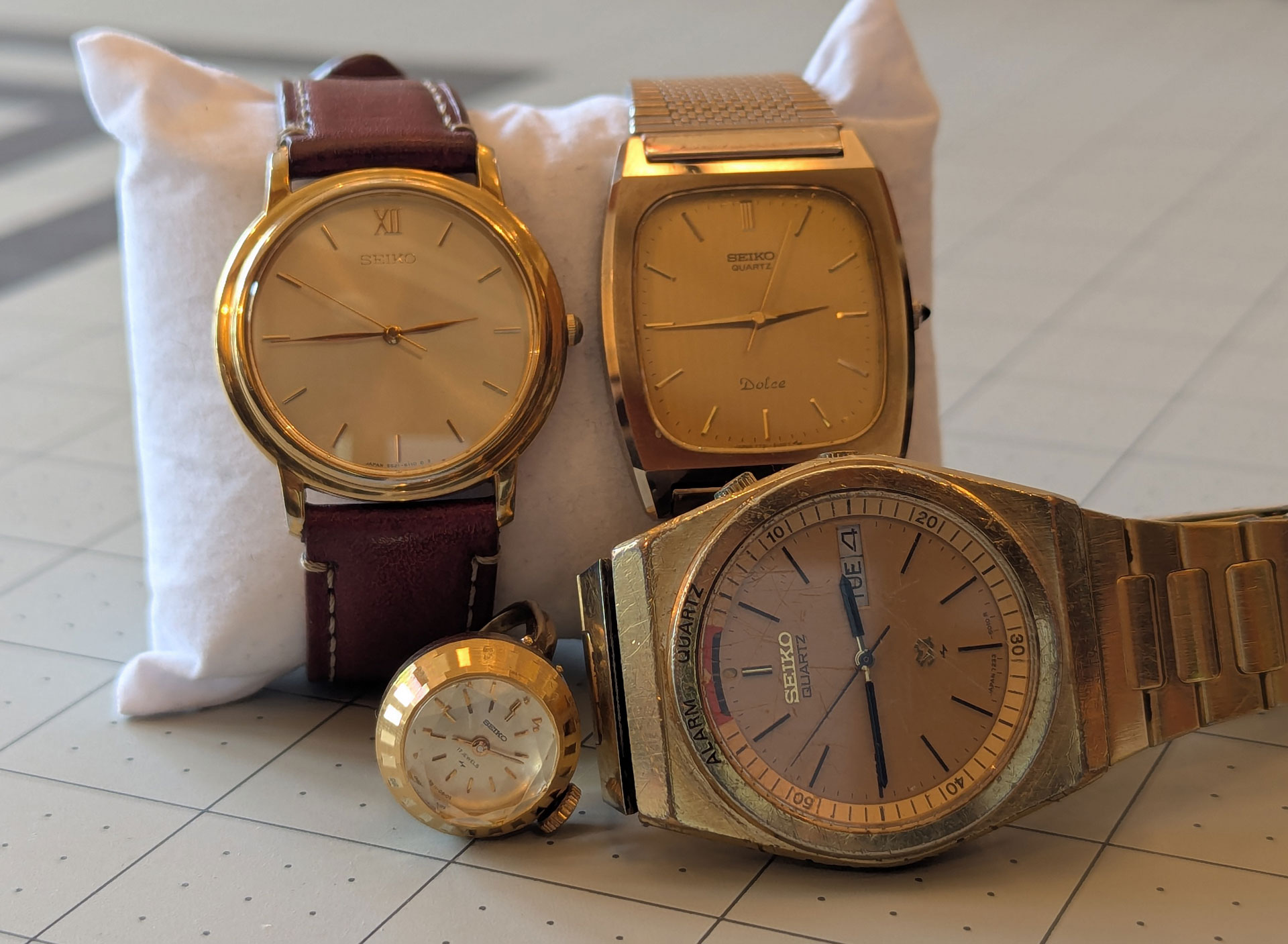
I've always had a general awareness of Seiko as a manufacturer of quality watches, but I've only recently added some to my collection. While modern Seiko watches tend to be a bit out of my comfort zone, price-wise—somewhat more expensive than the typical Casios in my collection—I've caught the vintage Seiko bug and quickly ended up with these four vintage pieces that seem fitting for a followup to my last post. The watches I'm featuring in today's post really are all older—for the most part—and gold-er than the Casios I featured in the previous article, and this time we're featuring all-analog watches. Just like the Casios in my last post, each of today's watches has at least one notable aspect that bears mentioning and gives it a degree of novelty earning it a spot in my collection; however, none of them (except perhaps one, which we'll save for last) is brimming with quite so much pizzazz as the Baby-G with the break-dancing stick figure living inside it.
I'm going to go over them in reverse chronological order, but keep in mind that the manufacture dates I list here are approximate. Seiko's serial numbers can be decoded to tell the month and year of manufacture for a watch, but they seemingly roll over every ten years. So, in certain cases I've had to make educated guesses as to the decade they were made, even though I know the month precisely.
Without further ado, let's take a look at four golden oldies from Japan's other major watchmaker.
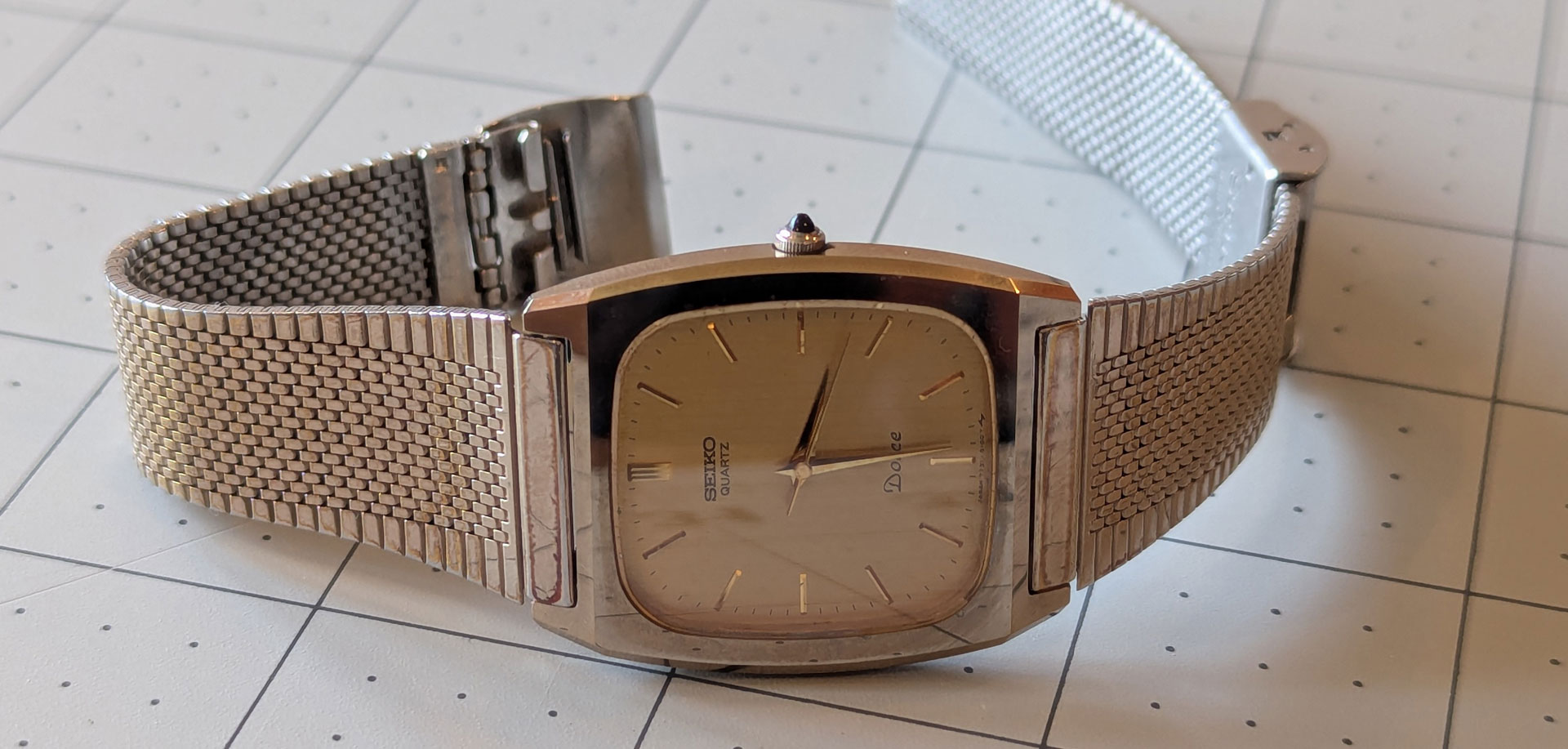
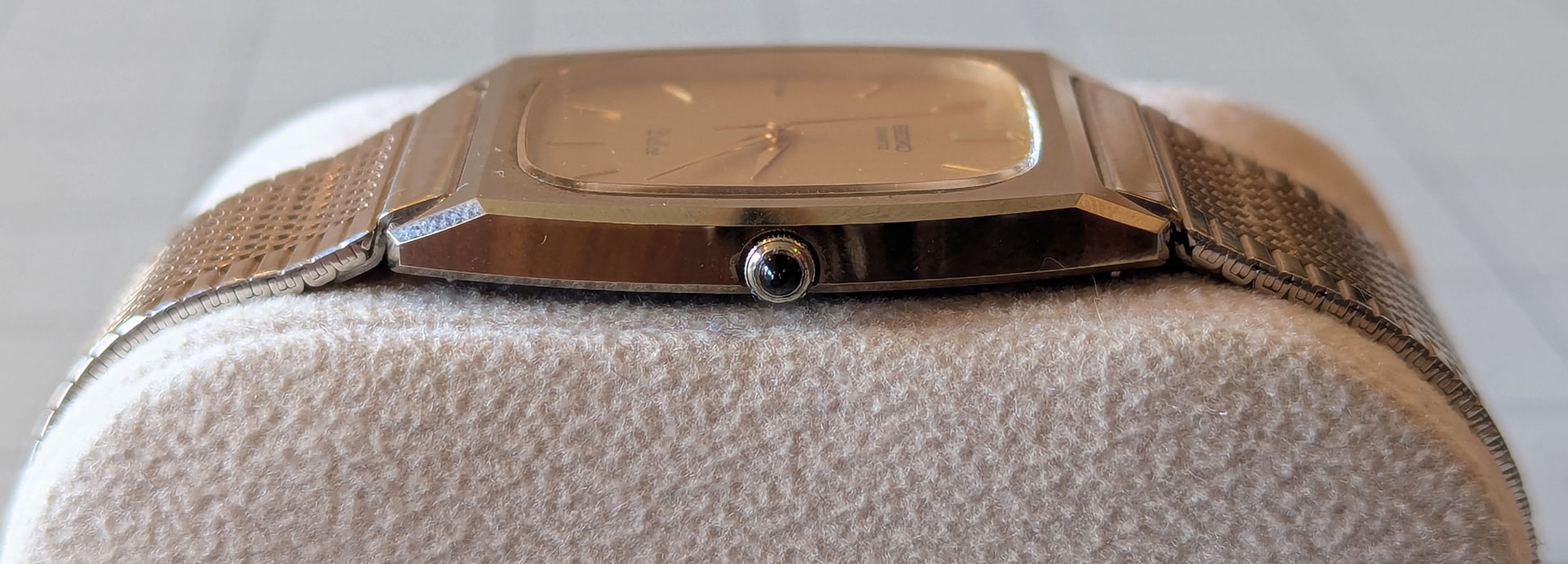
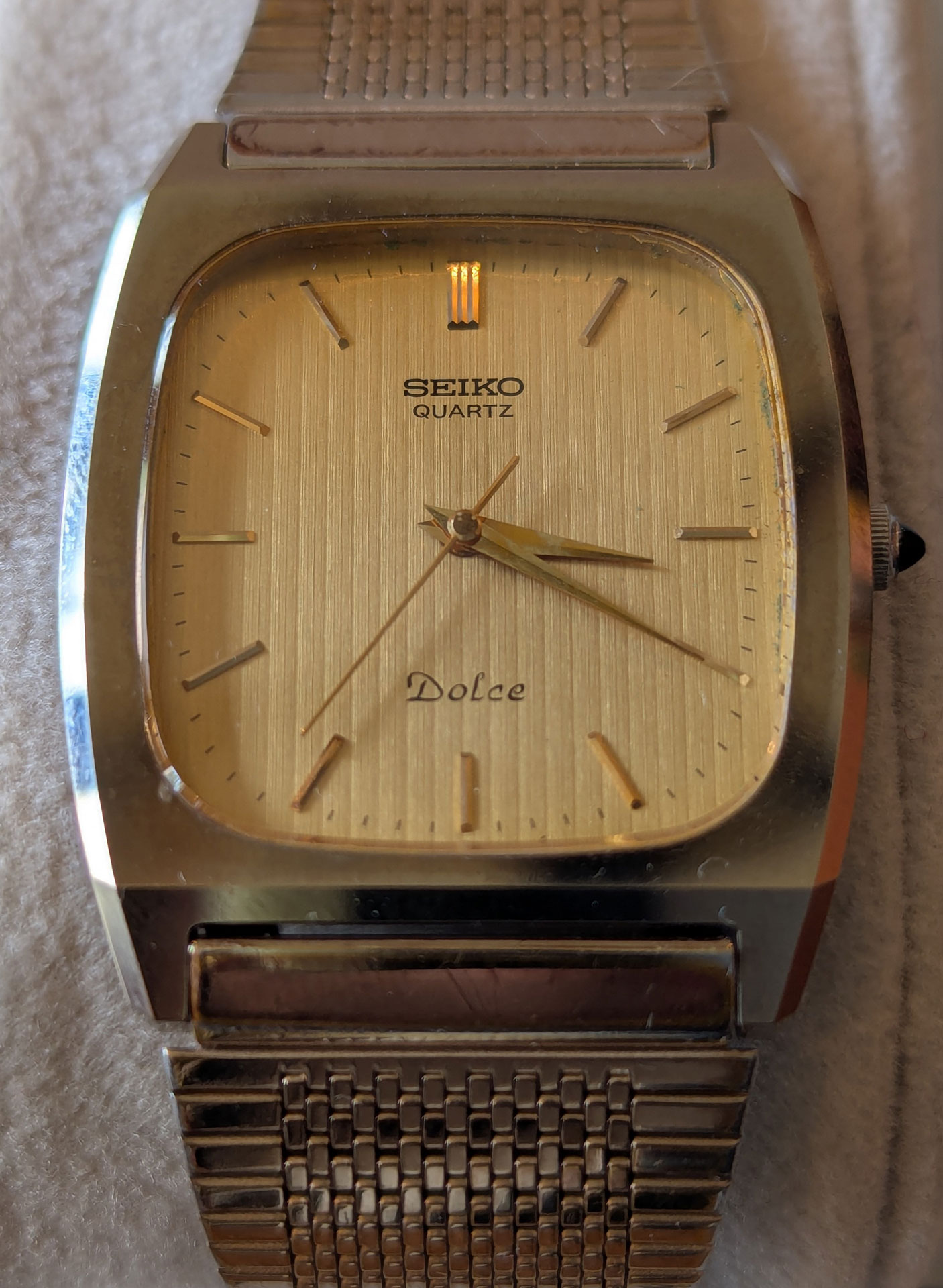
The first watch in today's post is the Seiko Dolce 7731-5091, a slim dress piece that has no difficulty slipping under a shirt cuff from March of 1993. It's a classy little number with gold hands over a gold dial with an almost-gold case. In some lighting it looks very silvery like steel, while in other lighting it's an almost champagne color. Either way, the case is highly polished and made of a material Seiko refers to as “NSA” or Near-Scratchless Alloy: a super-hardened material, possibly tungsten carbide, that is much more resistant to scratches than stainless steal. It also has a sapphire crystal, something fairly uncommon on lower-budget Seiko watches today. As a result of these materials, despite its age, this Dolce still looks very fresh.
That case material is one of the desirable high-end features of this watch, but it's not something I was initially clued into when I started looking at the Dolce line. I read they had alloy cases and foolishly assumed that was a bad thing and meant what it usually means for cheap watches: that it's not stainless steel. But super-hardened alloy like tungsten carbide is actually a fairly rare case material that is somewhat uncommon in the watch world because it is more brittle and slightly harder to work with than steel. So what I originally wrote off as a weakness turned out to be one of the Dolce's secret strengths.
If not the novelty of the case material, then, what was the interesting aspect that drew me to the Dolce? Herein lies my only regret with regards to this watch: I inadvertently bought the wrong watch in the heat of the eBay hunt. What originally drew me to this style of Seiko Dolce was in fact the movement some of them contain: a high-accuracy quartz caliber which my Dolce sadly lacks. The Dolce 5E61-5A00 looks very similar to this watch, but features the 5E61 movement which is rated for the very impressive accuracy figure of +/-10 seconds per year. For context, most decent quartz watches will typically be within +/-30 seconds per month. My 7731 here is less accurate still: it's actually one of the least-accurate quartz watches I own, gaining about a second a day; that's better than you'll get out of most mechanical watches but it's not exactly impressive. Oh well. It's not the end of the world, of course. Most people would likely neither notice nor care about such a thing and I'm still happy with this watch, but my mistake should be a lesson to all amateur watch-hunters to not overlook these little details when searching for a bargain. In the future, I may pass it on to someone else and pick up one of those 5E61s. So, if anyone's looking for an otherwise-great vintage dress watch, this one may be available!
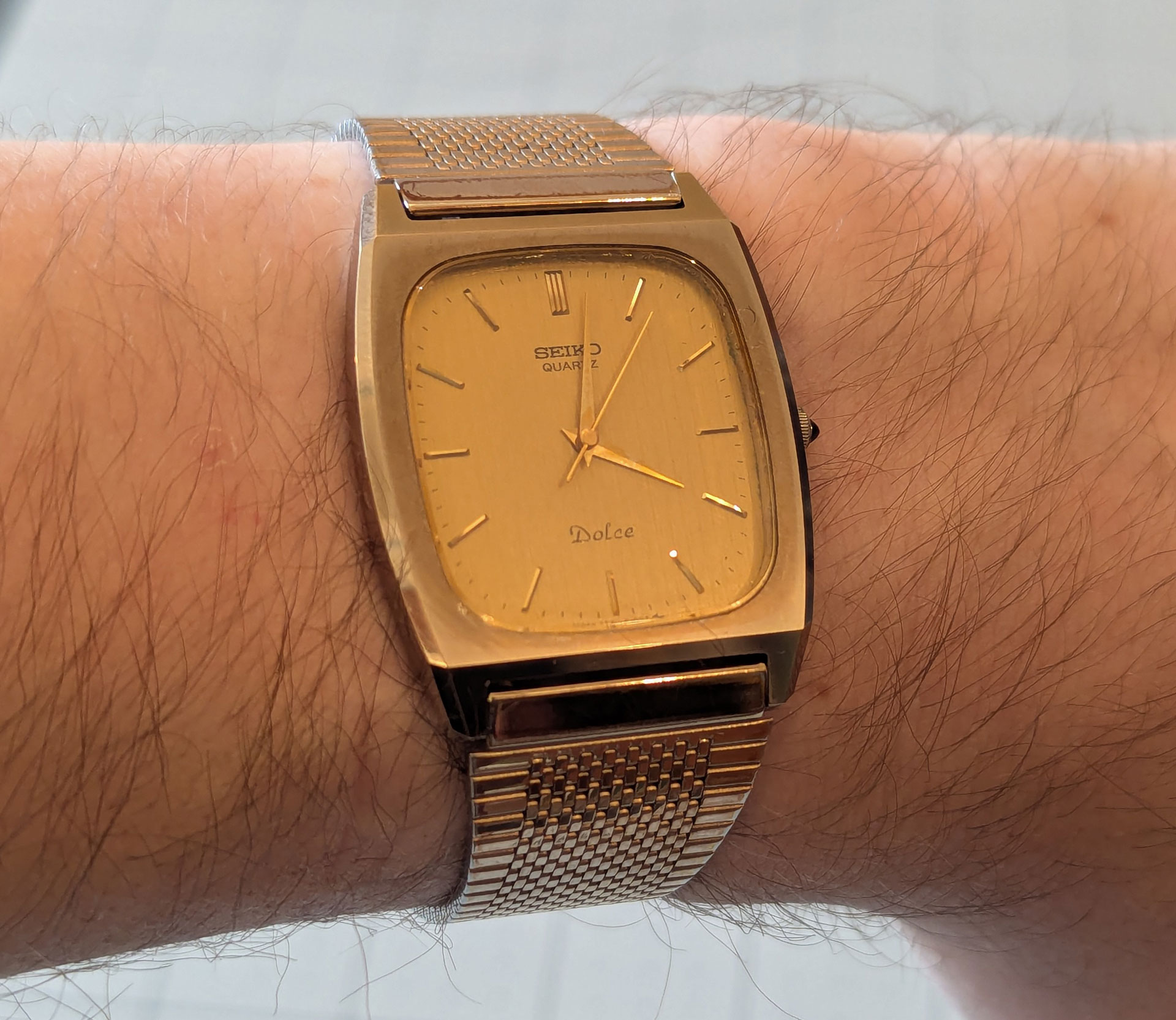
Looking past the rather mundane caliber powering the watch, there's a lot to like about this watch. The subtly tonneau-shaped1 case and rounded rectangular dial make for an interesting profile that expertly threads the needle between looking bold and unique and yet instantly classic. There's something about it that just looks good. The pointy cabochon2 crown may not be to everyone's taste, but I think it suits the watch, though it is a bit small and therefore fiddly to set the time with. But that crown is as big as it can be. The Seiko Dolce is, to invoke hyperbole, paper-thin! Seiko managed to fit this 3-hand analog movement in a case appreciably slimmer than a Casio F-91W. I'm not sure that's actually much of a technical achievement, but for someone who's grown accustomed to some rather chunky dive watches in the past few years, something like this is a breath of fresh air.
The vertical striped texture on the dial plays nicely in the light, changing appearances at different angles, and the hands and applied indices are well-finished. It's gold on gold, which is not exactly the most legible color scheme, but I have no trouble reading the time. The movement it contains, while unlikely to win any accuracy contests, is quiet and successfully lands the second hand squarely on each of the markers (avoiding two common pet peeves among quartz watch owners).
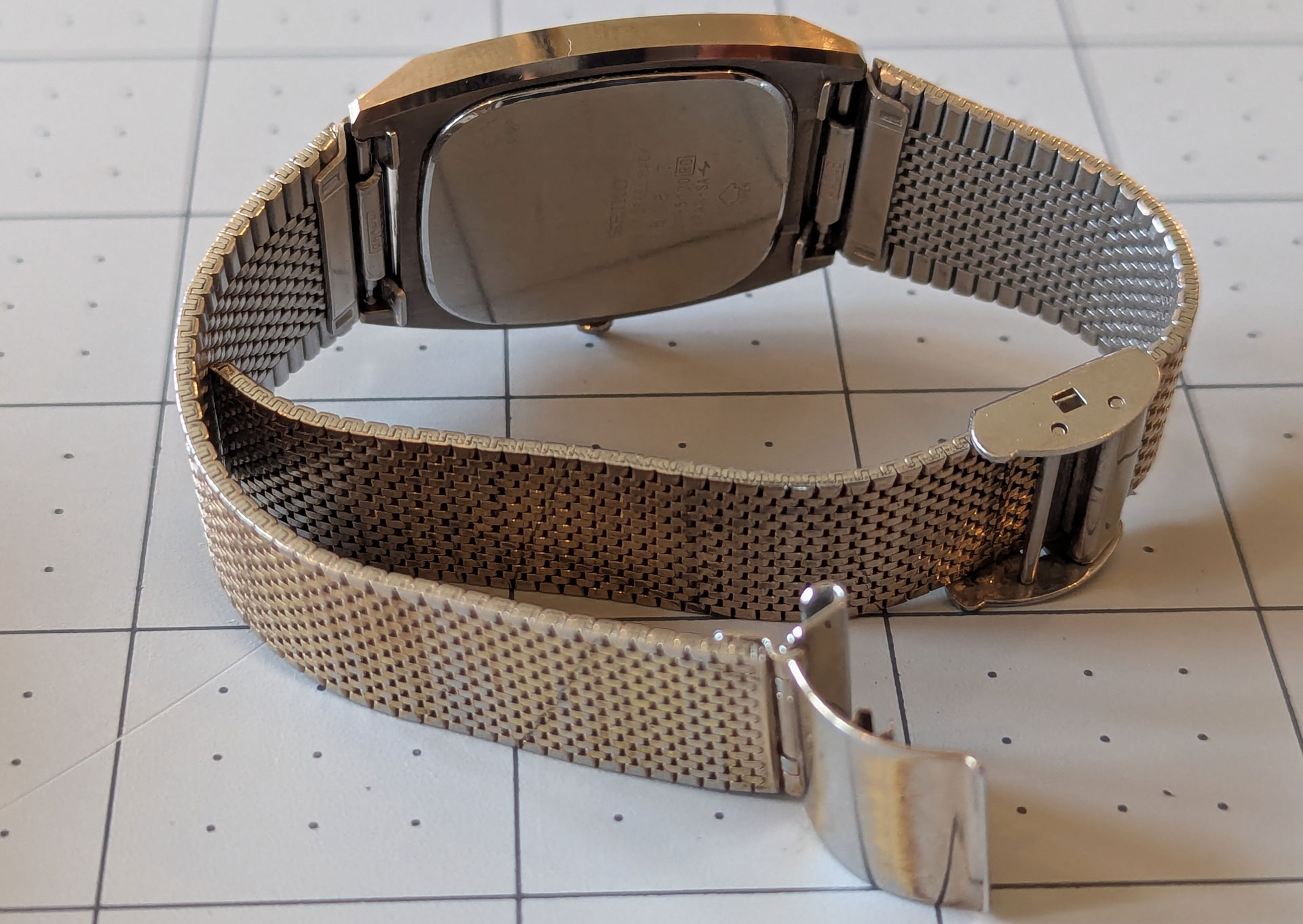
The bracelet is classy and comfortable, one of those easily-adjustable ones you often see on Casios and Seikos of this vintage. I'm not exactly sure how to refer to this style of bracelet, with its array of tiny links—it's somewhere between a “beads of rice” bracelet and mesh strap.
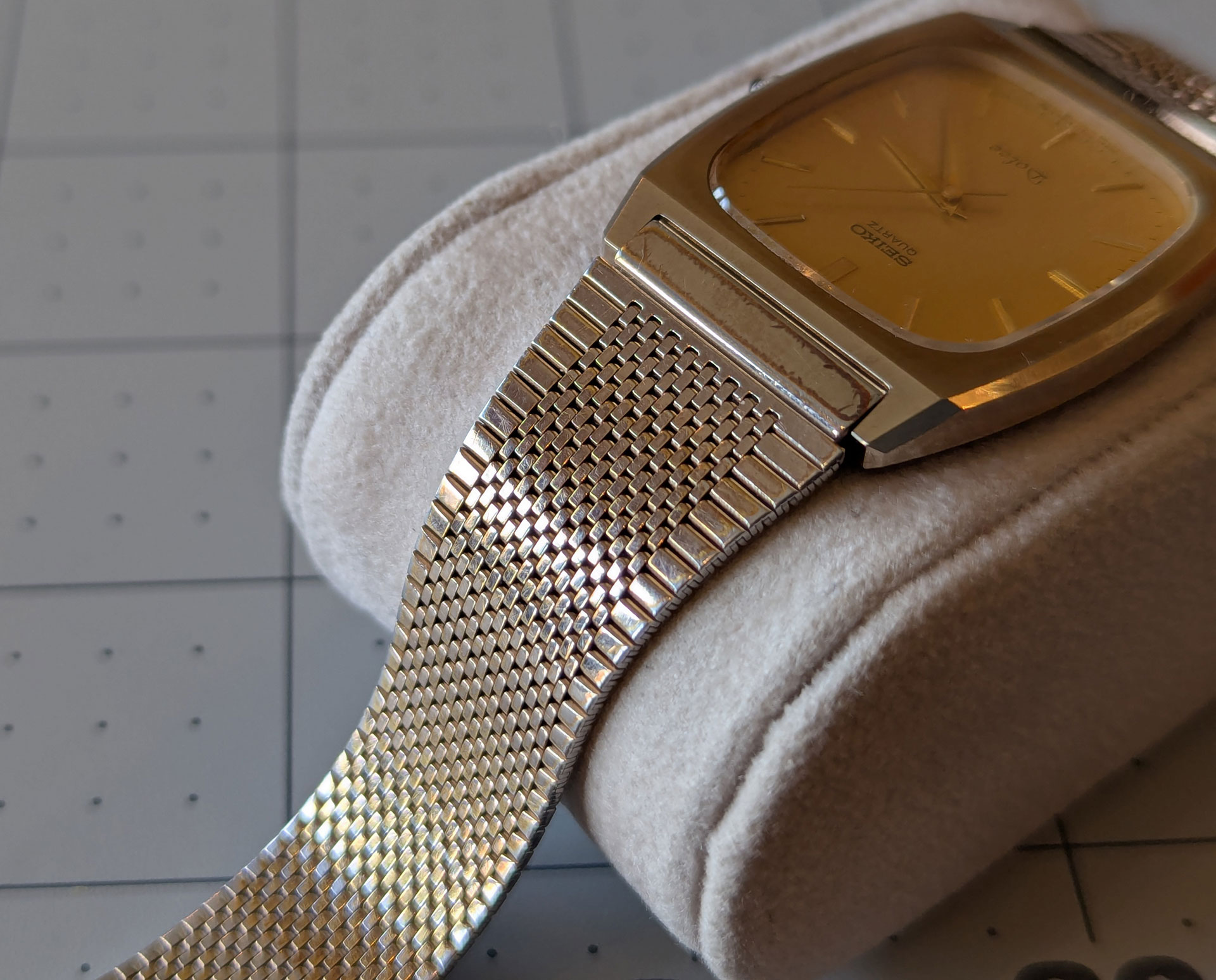
While the finish of the hardened alloy and sapphire crystal have held up perfectly over the years, unfortunately the condition of the watch is not entirely spotless. There's a kind of patina on the bracelet, especially noticeable on the endlinks and clasp, that appears as a sort of brown stain. My best guess is that there was some plating or coating on the bracelet to match the color of the case that has degraded over time. Something similar is going on with the hands which reveal some discoloration at just the right angle. It doesn't really stand out much, but it's one of the few giveaways that this watch really is over thirty years old. Arguably, that gives it some character.
1 Tonneau is French for “barrel” and refers here, appropriately, to a watch that's shaped like a barrel: flat on the top and bottom with rounded sides. I say subtly-tonneau shaped because to my eye this watch is more or less a rounded rectangle, but under closer scrutiny I must concede that it is, in fact, slightly barrel-shaped after all. back
2 A cabochon is a cut of gemstone which has been polished but not faceted. In other words, a cabochon crown is a crown with a smooth gemstone set in it. back
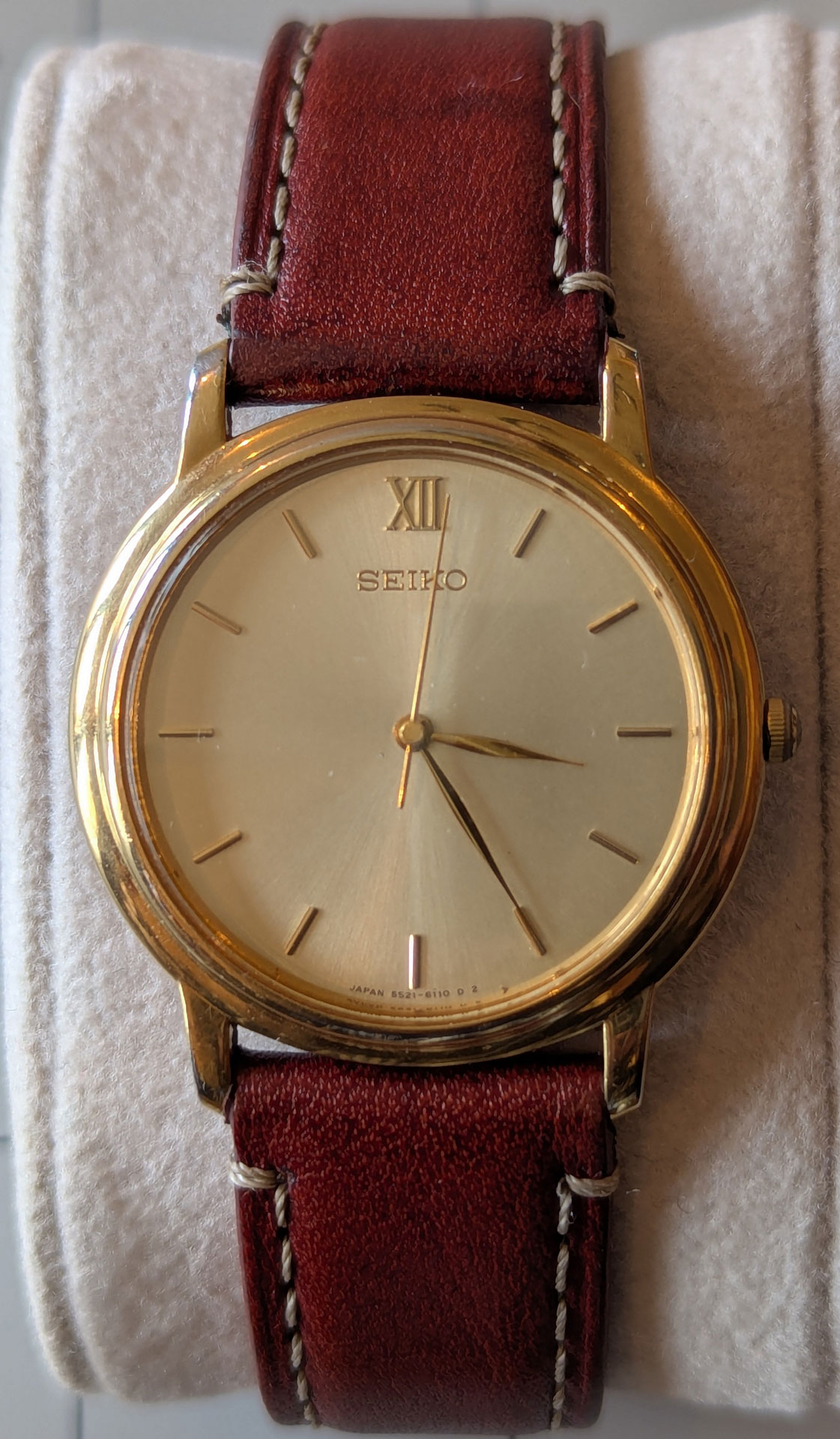
After I found the tonneau-cased Dolce on a metal band, I had my eye on getting a different member of the prolific Dolce family for reasons that will become apparent later on. My logic went something like this: having gotten a rectangular watch on a metal bracelet already, my other Dolce ought to be round on leather. And so it is.
This watch is perhaps my favorite of today's watches, all of which are special for different reasons, but it is also a bit of a mystery to me. Looking online, it appears there's really two different designs that bear this model number. Some of them look like mine, while some of them are branded Dolce on the dial and feature a different gold texture and a baton at the 12 o'clock in lieu of the single roman numeral XII that mine has.
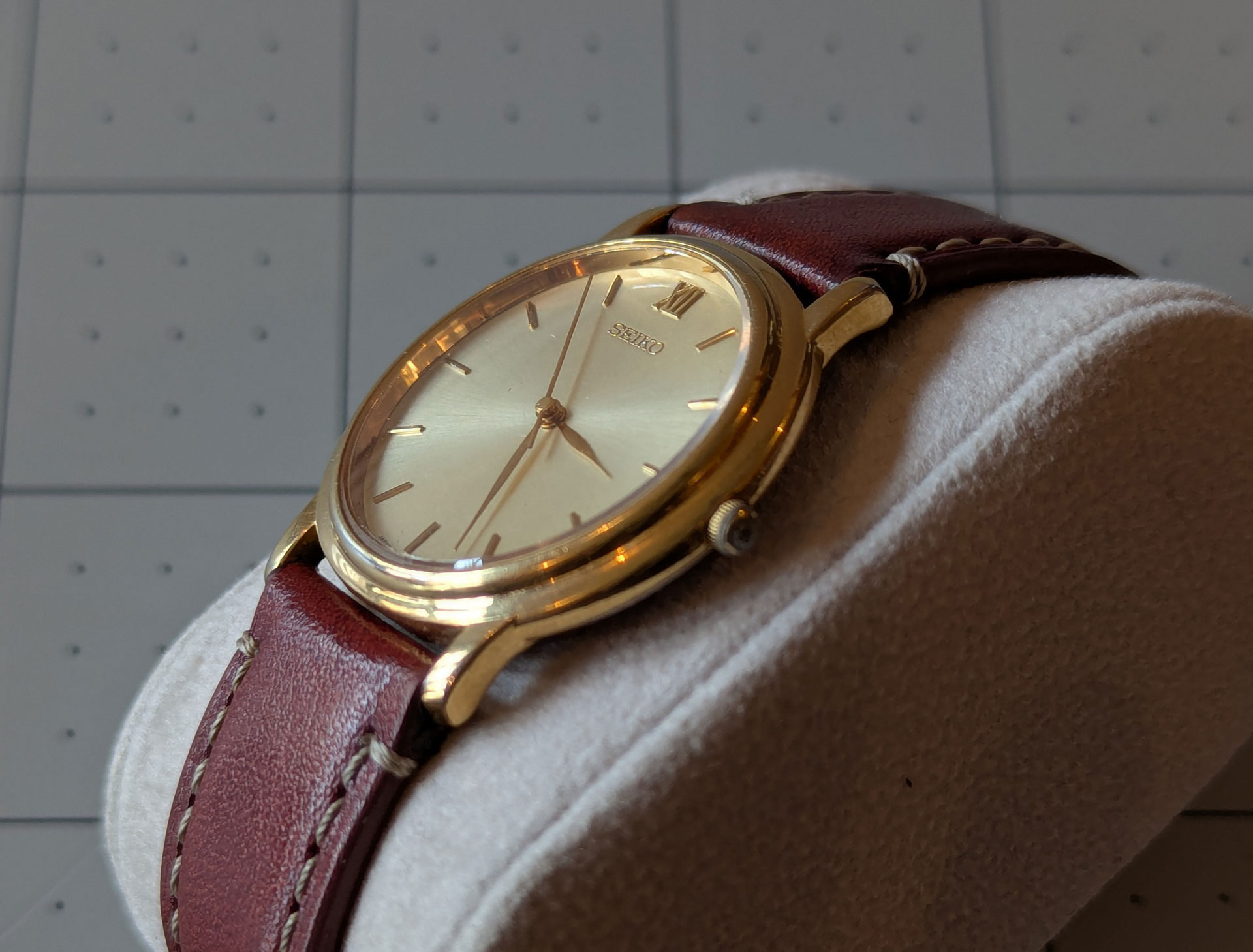
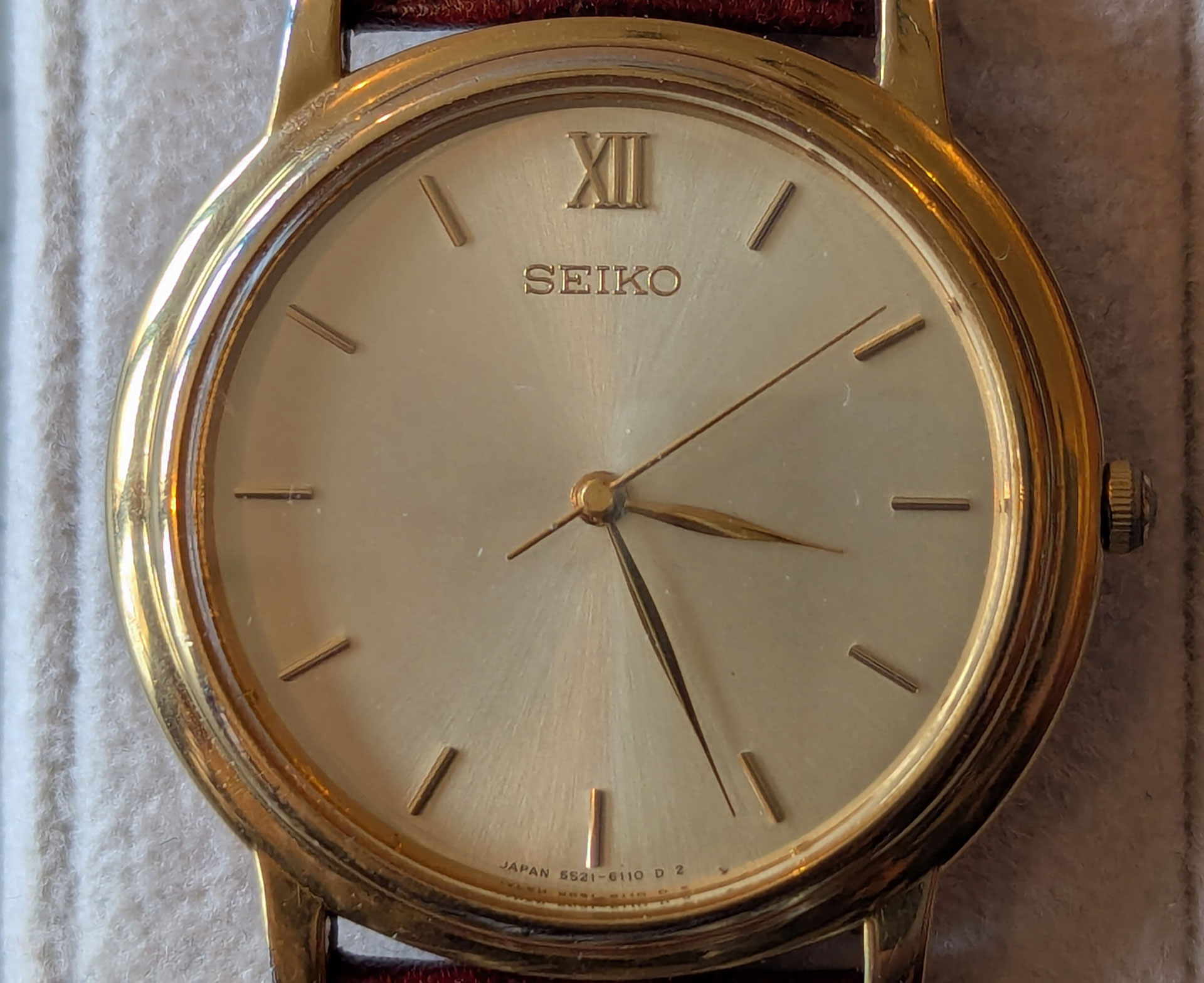
Of the two designs, I have to say I prefer the one I have. The dial has a subtle golden sunburst effect that sparkles nicely in the light but doesn't get in the way of legibility. Otherwise, the design is simple and elegant. The hands are well-finished in high-polish gold, and there's a smooth cap over the center pinion3 which gives it an extra little touch of sophistication. The crystal is most likely sapphire but I lack the tools to test that for certain; regardless, despite its age, there's not a scratch to be found on it. The case material appears to be some kind of gold-plated alloy, with a stainless steel back.
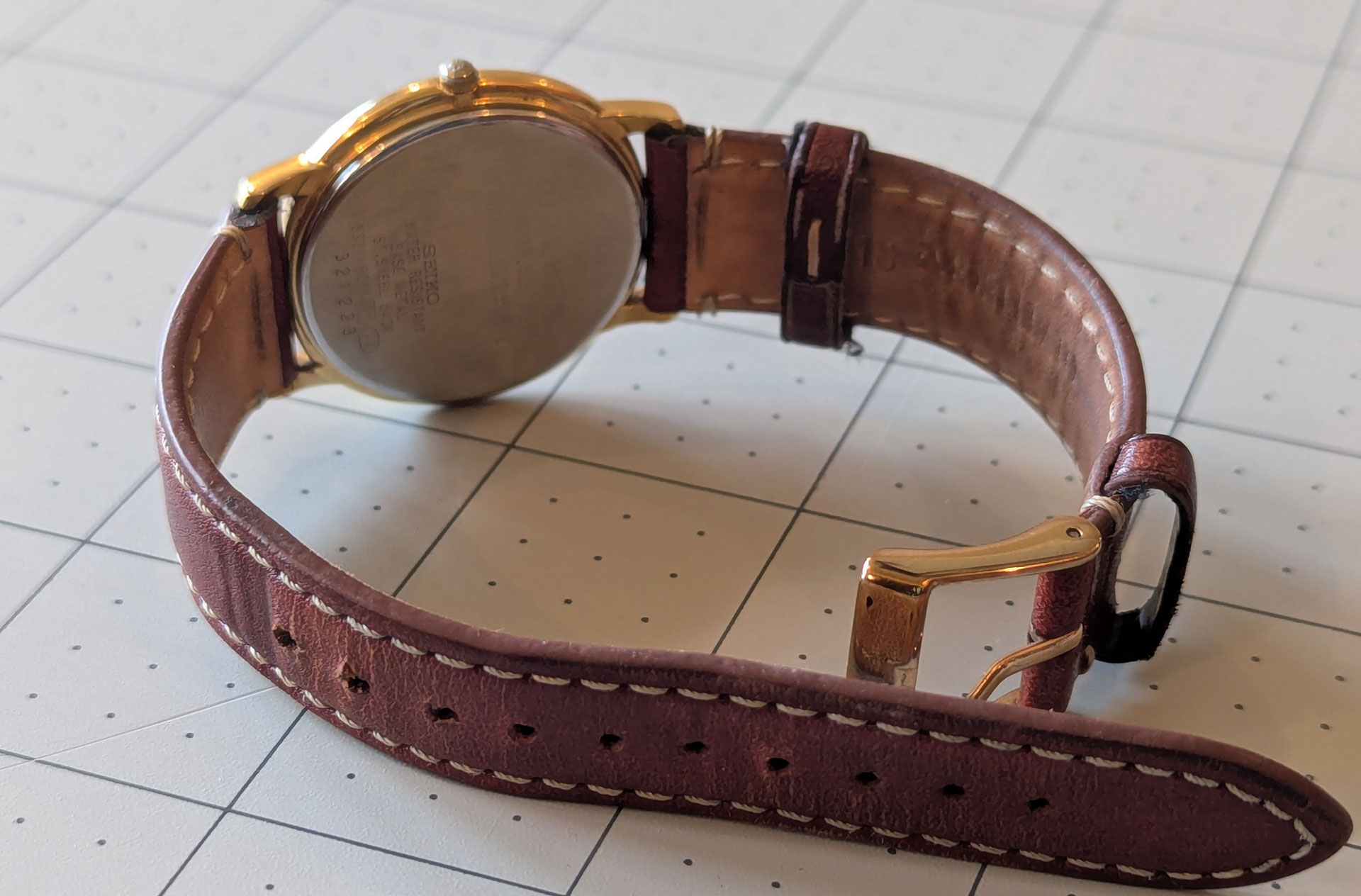
The leather strap on mine seems like it may not be original, but it's well-made, pairs nicely with the watch, and has matching hardware.
This was marketed as a men's watch but by modern standards, it's tiny at a mere 32mm in diameter. That means it fits my small wrist quite well, but the larger-wristed may prefer one of the rectangular models (which are sadly in much higher demand). Beyond how it looks on the wrist and potential difficulty setting the time with its petite crown, this small size doesn't interfere with the design or readability. With a very narrow bezel, the dial is still a good size and everything looks proportional.
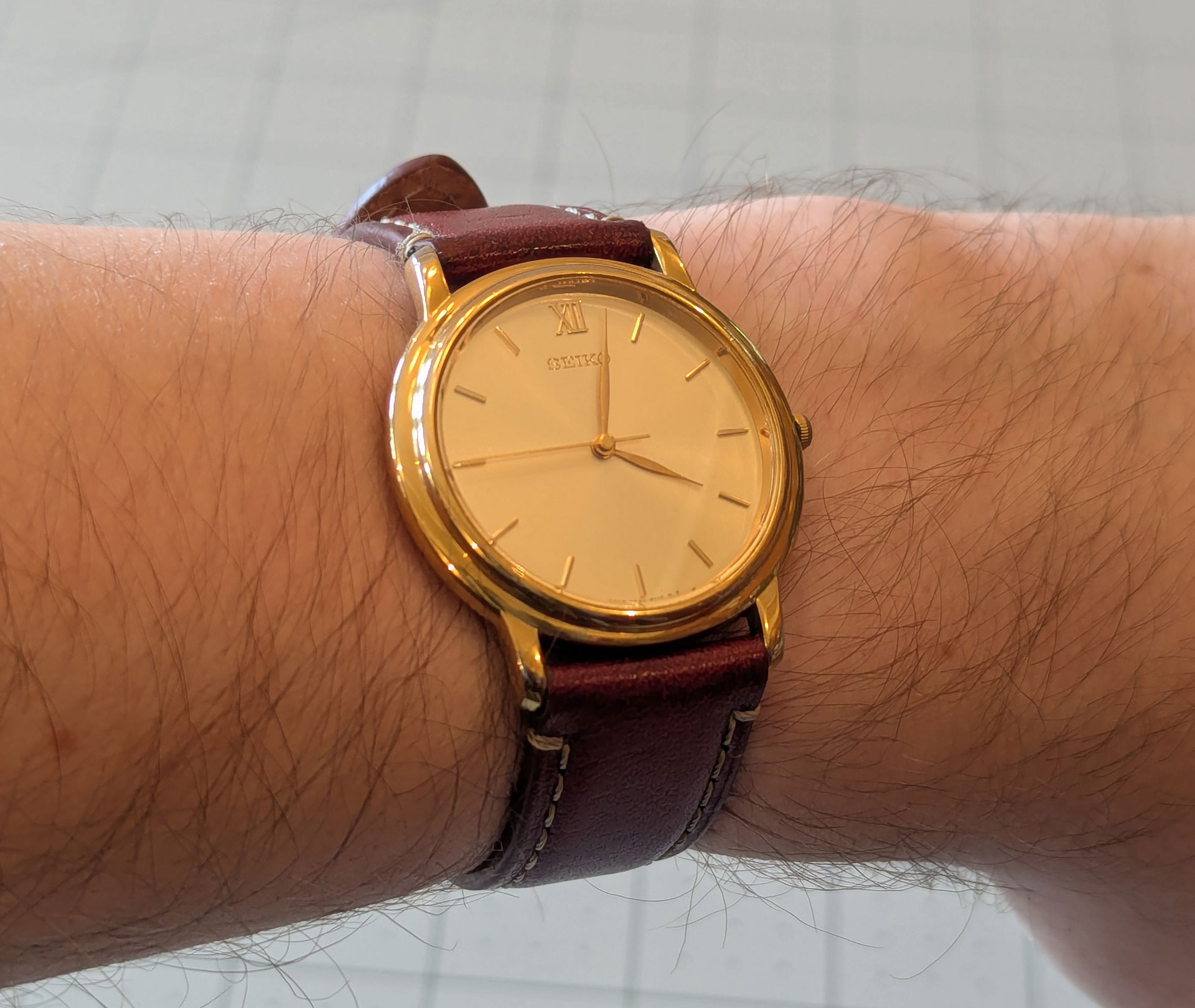
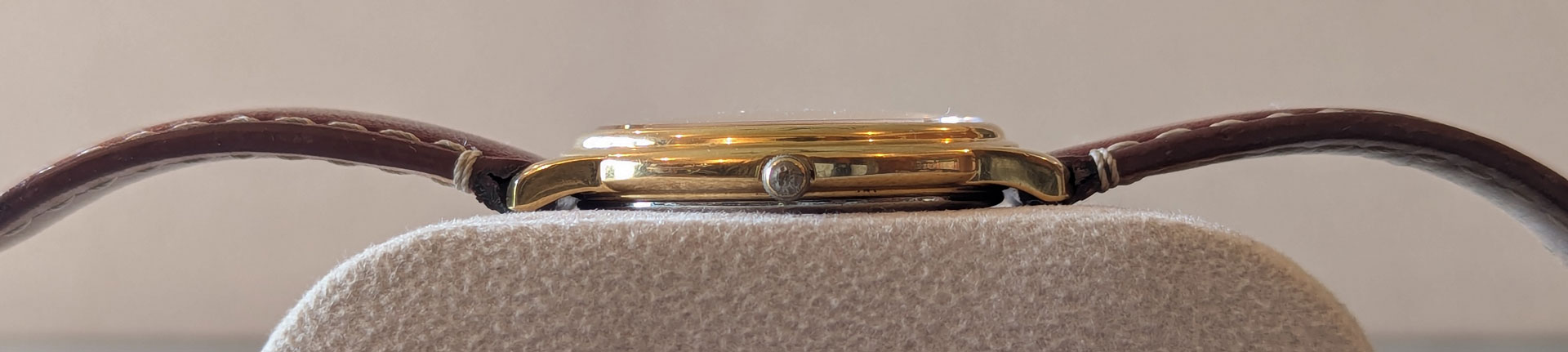
Like all the Seiko Dolce models, the 6011 is light and extremely thin. It's easy to forget you're wearing it. I was worried this size and featherlight weight would make the watch feel cheap but the excellent finishing and design results in a watch that feels luxurious and elegant without being overly showy.
I can say with relative certainty that the manufacture date for this watch, based on the serial number, is February 1993. How do I know it was '93 and not'83? Simple: because the caseback in inscribed with a date in May of 1993. It appears that this watch was given as a twenty year service gift to employees of a particular company in Japan, and it's not the only one. All the other examples of this model that I found online (as opposed to the Dolce-branded one with the same model number) had similar inscriptions. So my best guess is that all the 5S21-6011s that look like mine came from a batch of custom watches to be presented as corporate gifts.
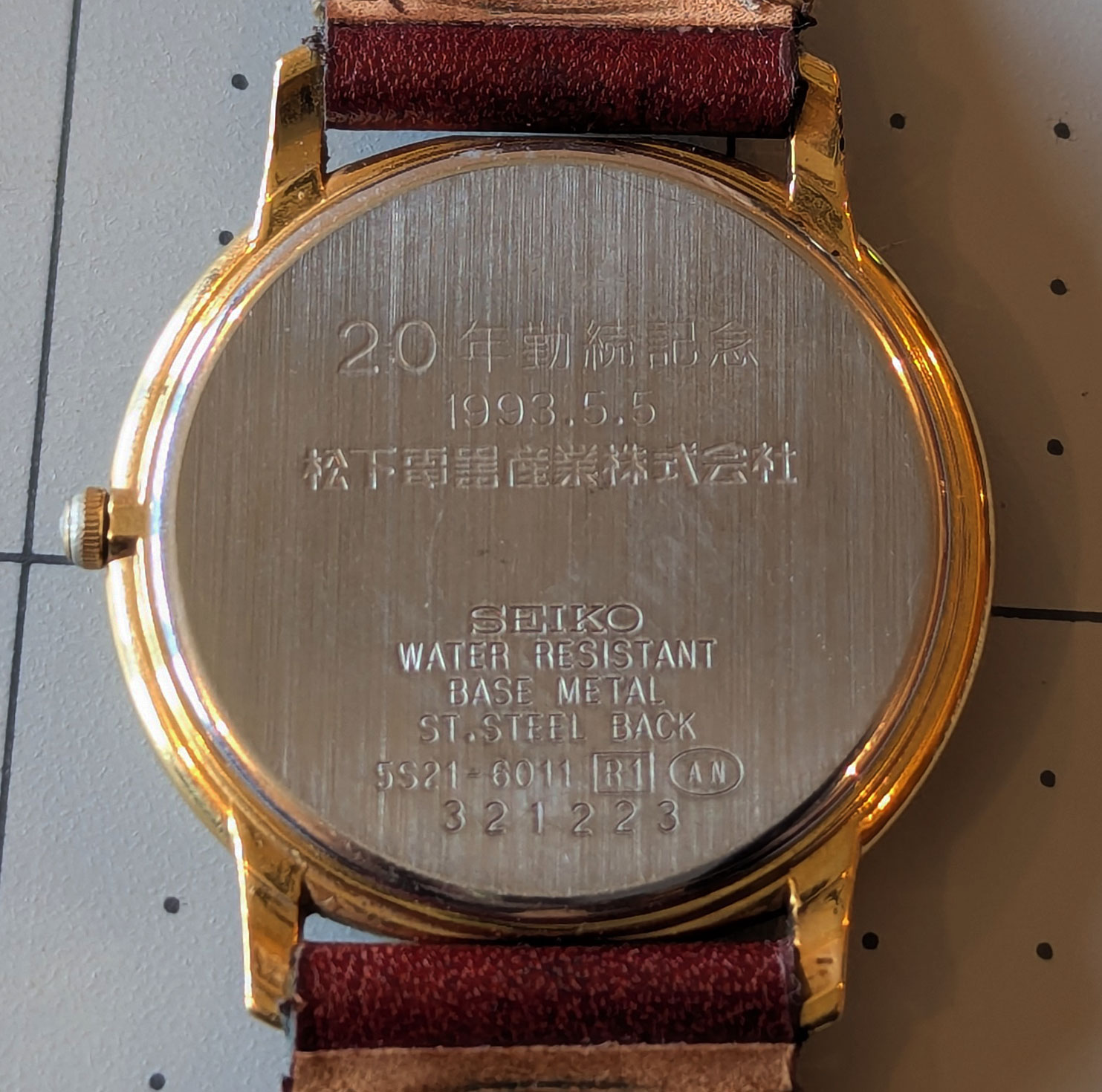
The engraved caseback of the 5S21. Text reads: "20 years of service commemoration, Matsushita Electric Industrial Co., Ltd." (Machine Translated)
Beyond the mystery of the two different designs for this model, there's another really special feature hidden in this otherwise-unassuming watch: the magical 5S21 movement. Despite its appearances, this is not a high-beat mechanical movement. In fact, if you look closely, you'll notice that its second hand sweep is actually smoother than that of a 28800 vibrations-per-hour mechanical movement. There are no discernible steps to its motion: the hand's movement is perfectly smooth as it glides over the face of the watch. The S521 was produced for only a few short years in the late 1980s and early 1990s and is actually a four-tick-per-second quartz movement—if you hold it up to your ear, you can here the ticking—but with a system to mechanically dampen the motion of the second hand into what you see here.
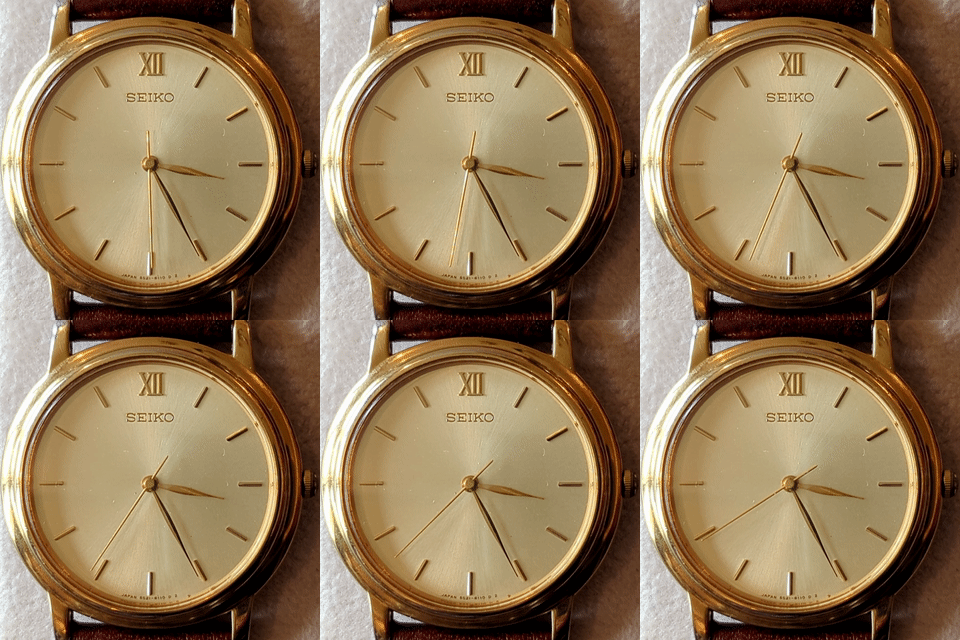
The only really comparable movements you can get today are Seiko's own Spring Drive (only found in very expensive luxury watches, mostly under the Grand Seiko brand) and the Bulova Precisionist (which offers better accuracy than the 5S21, but features in watches that will likely run you more than one of these Dolces). Some say that the 5S21 was a predecessor to the Spring Drive movement and that it was discontinued as a result of the development of Spring Drive, but that seems to be largely speculation. Spring Drive works fairly differently and is clearly targeting a different market.
The last thing to know about these 5S21 movements is that it's important to check their condition before purchasing one of these watches. That's a wise precaution with any vintage watch, but my understanding is that over time the oil of the dampening mechanism can start to dry out and it will start to stutter. Given the rarity of the movement, it's unlikely that a typical watchmaker or jeweler will be familiar with repairing this. Mine is thankfully running quite smoothly, at least for the time being.
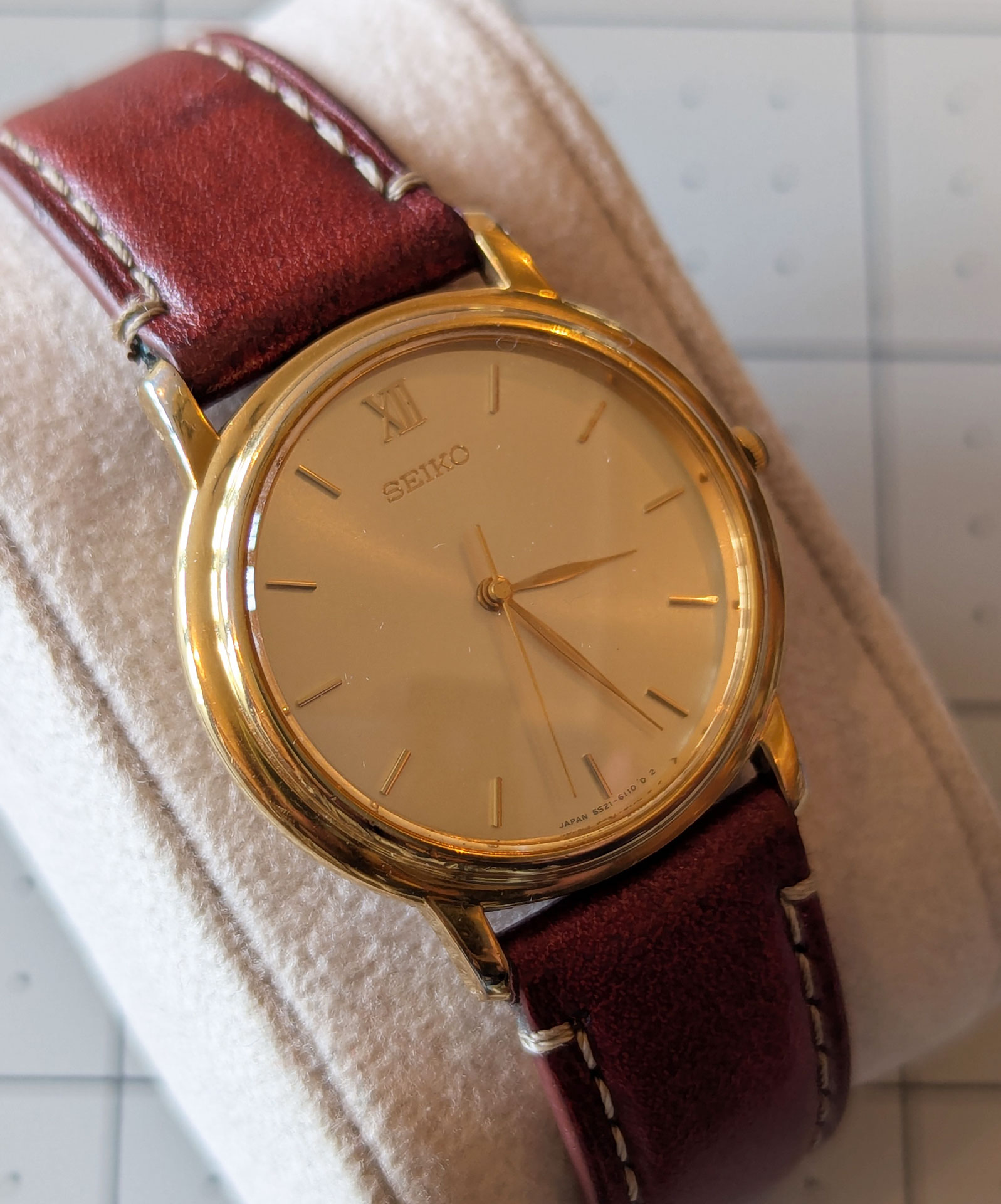
So that's the watch that completes my Dolce Duo, a fitting partner in crime to the previous 7731. Beyond complementing the other one I bought, there is another benefit to getting the 5S21 in one of these round cases: many collectors won't bother with these round Dolce watches; they're simply too small for their wrists, while watches of the rectangular persuasion tend to “wear larger” than their diameter would suggest as a result of a geometrical quirk whereby rectangles have no diameter and circles have got less corners to them. As a result, you'll find the round ones—no less charming in my opinion—are much easier to find and come in at half the price or less of one of the tonneau or tank-style4 Dolces with the same movement.
3 Where the hands attach at the center. back
4 Tank-Style watches are named after the Cartier Tank. They're rectangular watches with roman numerals. back
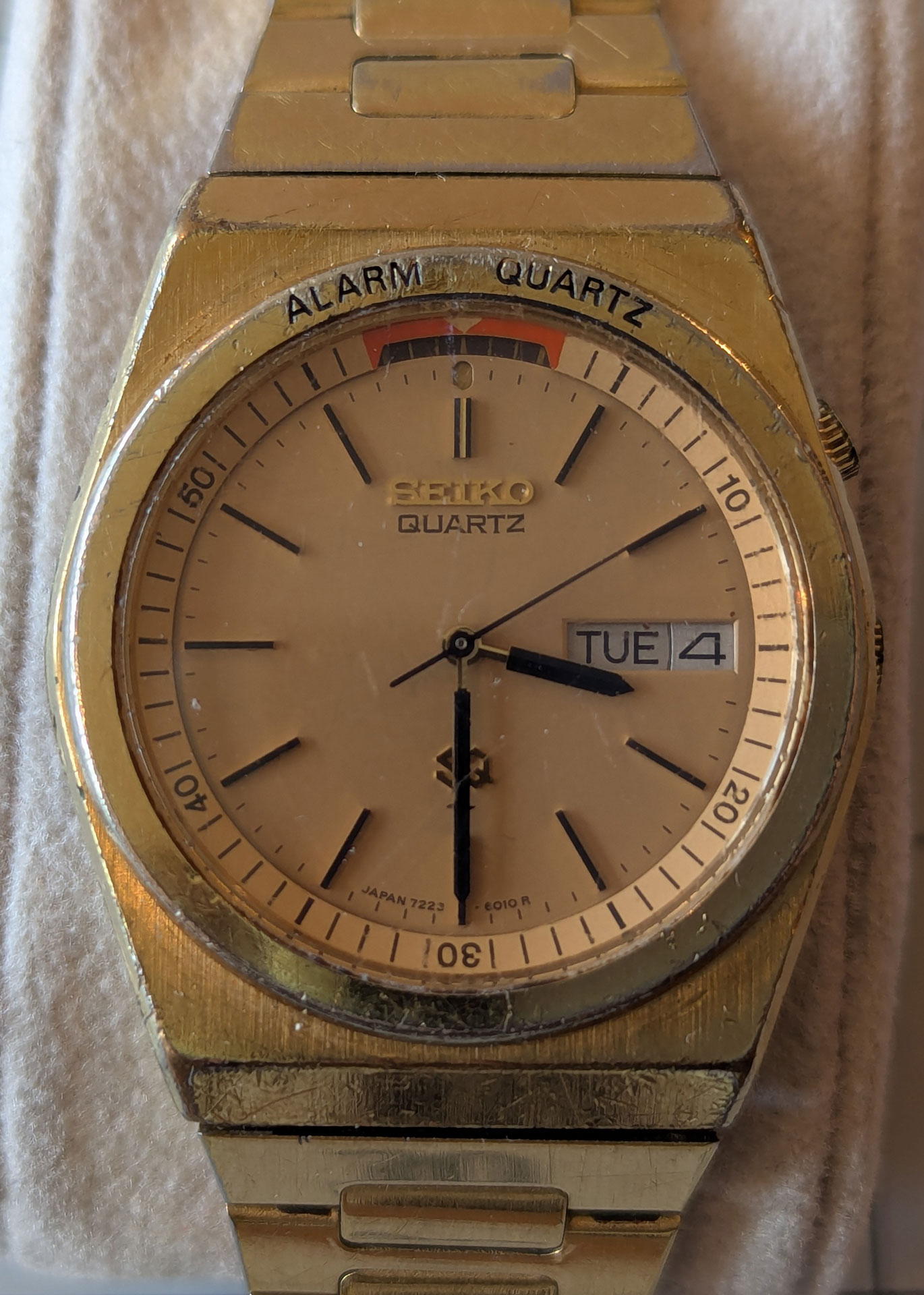
Up next in our vintage Seiko roundup is this Alarm Quartz. My best guess as to the manufacture date for this watch, based on the serial number, is March 1980.
The alarm heralded by the fading text on the bezel of the watch is of course what drew me to it in the first place. It features an ingenious system for controlling a beeping alarm using a second crown at the 2 o'clock position. When this crown is fully depressed, the alarm is silenced. Pulling the crown out one click enables the alarm with a quick beep to let you know it's on, while pulling it out a second click enables the user to set the alarm time using the inner rotating bezel. When the hour hand hits the time indicated by the bezel, the alarm sounds. The alarm indicator only rotates one direction—counter-clockwise—and clicks in roughly five-minute increments. Additionally, it has a minute track with a dive-style count up grading.
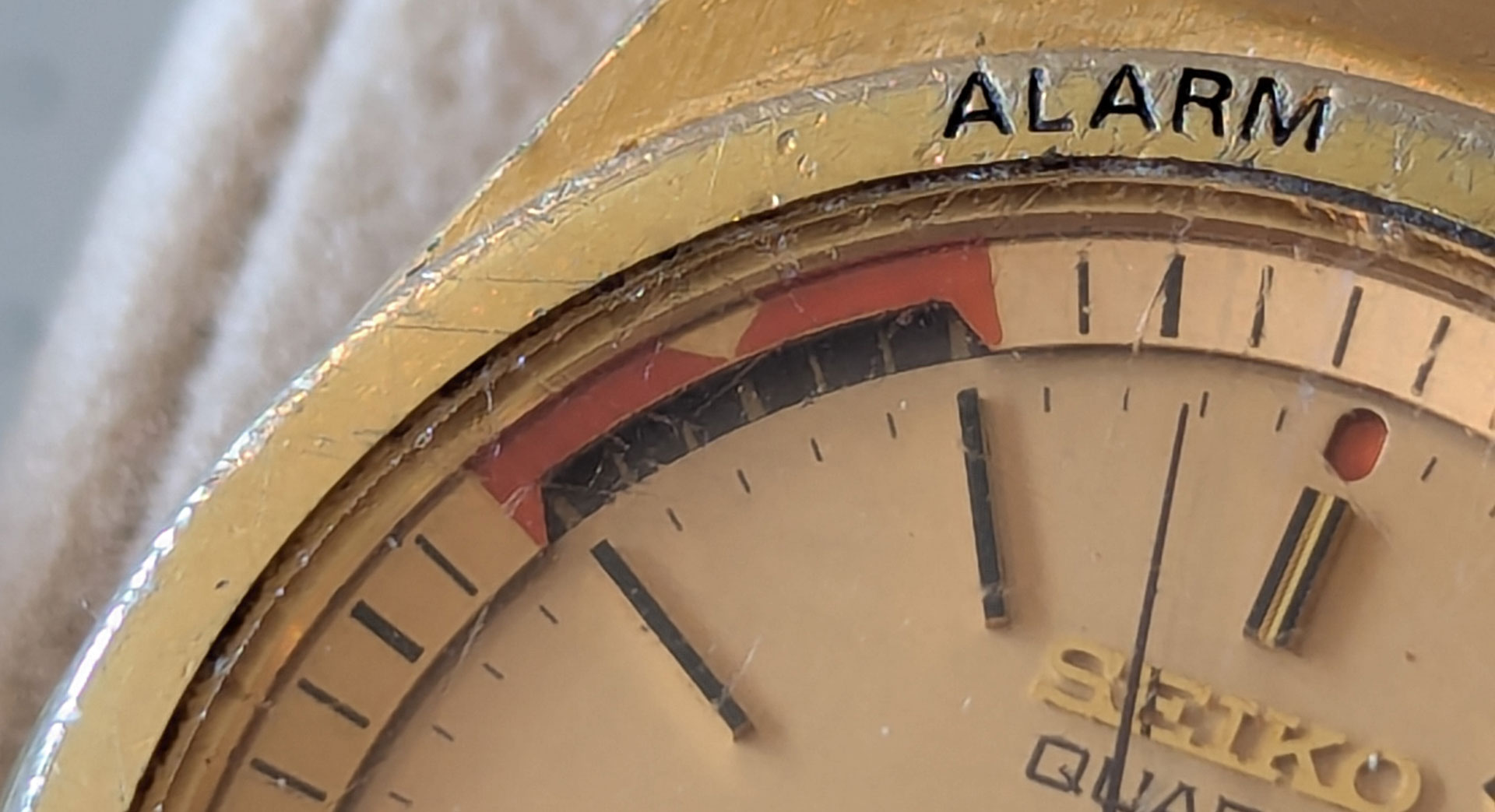
The bezel is marked with an area surrounding the indicated alarm time that helpfully shows the span of one hour allowing you to easily line up the half-hour point.
The last nifty little trick up the Alarm Quartz' sleeve is the small window at the 12 o'clock position which is a second indicator of the alarm status. When the alarm is off, this window shows the same color as the dial; when the alarm is “armed”, the window is blue; and when the alarm is in set mode, the window is red.
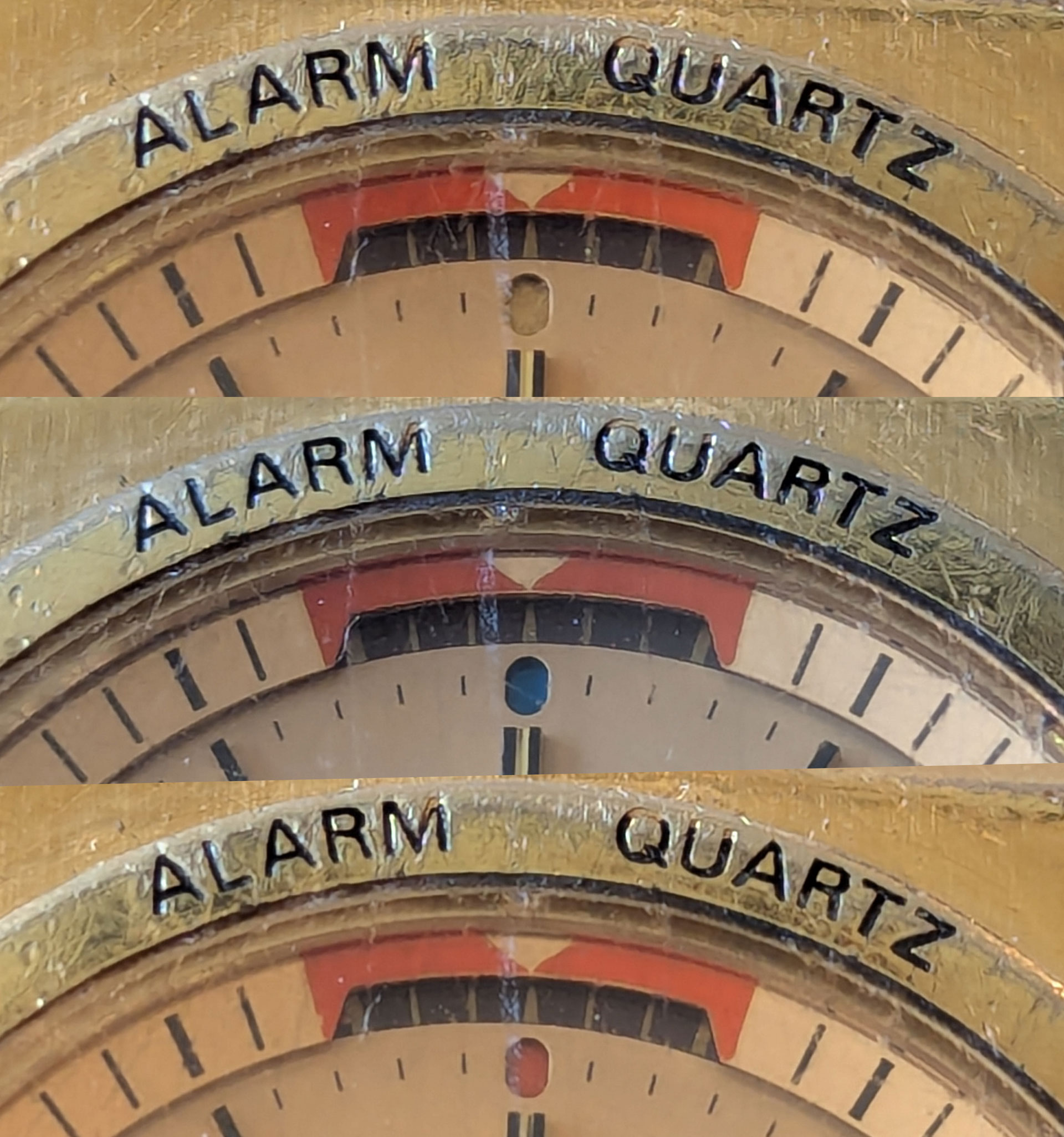
The alarm itself is surprisingly well-thought-out. I'd originally assumed it would beep in a standard repetitive pattern like every digital alarm watch I've owned from the likes of Casio. But in designing this watch, Seiko was far more considerate: rather than jumping right into the alarm at full-throttle, the watch first beeps once quietly—giving you time to silence it discreetly if you notice—then after five seconds or so before begins to beep in earnest, quietly at first, growing louder before eventually turning off after 30 seconds. This is a system that I wish more alarms employed. It's a nice gesture for those of us who stop the microwave at one second to avoid having to listen to the timer going off.
The alarm functionality, however, is not without its flaws. For one thing, a slight inconsistency in the alignment of the hands—at least on my watch—means that despite the way the bezel clicks into discrete positions, the alarm doesn't sound precisely at the time indicated, but rather about a minute afterward. For example, if you have it set for 6:00, it will sound at 6:01 or so. Beyond that, the tiny crown and unidirectional movement makes setting the alarm somewhat tedious. Lastly, though pushing in the crown to silence the alarm is satisfying and intuitive, this mechanism does pose one potential risk: that the wearer may inadvertently disable the alarm by bumping the watch into something in their sleep. Regardless of these minor quibbles, I think it's a brilliant way of incorporating this feature into an all analog watch.
The way this works, of course, is not a wholly original idea. This is, after all, essentially how most analog alarm clocks work, as well as various other alarm watches made beforehand. Analog alarm watches are rarely seen today but were at one point relatively commonplace. The Alarm Quartz is the spiritual successor to the popular Seiko Bell-Matic line of mechanical alarm watches from the 1960s and 70s. Like the Alarm Quartz, the Bell-Matic featured a second crown for controlling the alarm and an inner-rotating bezel to show the alarm time. Unlike the Alarm Quartz, the Bell-Matic's alarm sound was produced by a little hammer rapidly striking the case to produce a harsh (but quiet) buzzing sound that would alert the wearer. I think I'd like to get a Bell-Matic someday, but they are a bit more desirable (and therefore pricier) than their newer quartz cousin, and the nature of their mechanical operation makes them more prone to issues with reliability that might require servicing while a quartz watch should hypothetically keep working without a problem indefinitely as long as you put a battery in them.
It's evident that the years have not treated my Alarm Quartz quite as kindly as the previous watches discussed. I bought this one in very rough and tumble shape on a whim because it was a bargain. In fact, when I got it, it was quite a lot worse than you see here, but even after a thorough cleaning it's still showing some scars on its crystal and gold-colored plating. I tried using Polywatch to buff out the surface scratches on the crystal, but because this is mineral crystal and not acrylic, I didn't have much luck. Besides its cosmetic woes, I found that the two crowns were quite difficult to pull out. I removed the back and uninstalled the stems and gave them a good cleaning but it's still more resistive than I think it should be and that's as far as my abilities take me in terms of addressing the issue. So while everything on the watch is functional, it can still be a bit of a pain to set the time. Still, once you look past its mostly superficial weathering, you have to admit that the Alarm Quartz is quite charming.
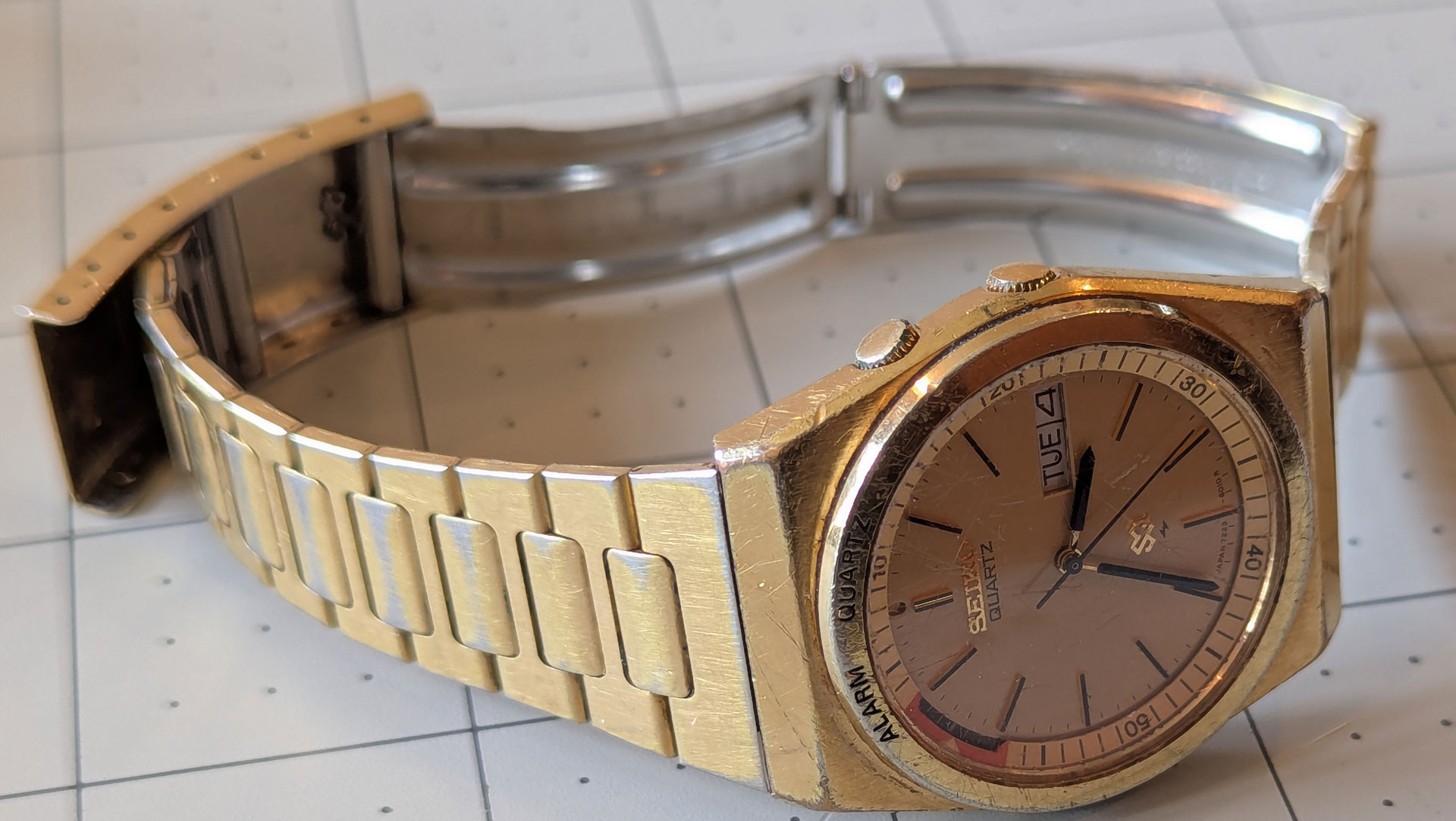
At first glance, it appears to be a simple integrated-bracelet watch not dissimilar to the Tissot PRX or the Casio MTP-B145D, both of which have been highly popular in recent years albeit in different sectors of the market. In fact, to my eye it looks so similar to the gold-on-gold PRX that I think you could easily mistake the two from a distance. Drawing such comparisons only serves to highlight the timeless design of the Seiko which predates the modern Tissot by some forty years. Moreover, it speaks to the fact that both take heavy inspiration from the Rolex Oysterquartz, which is no doubt what Seiko had in mind in when they designed this one in 1980.
I think the design is just about perfect. It elegantly fits the day and date complication as well as the alarm and count-up bezel onto the face of the watch without making the design too cluttered. I also like the SQ (Seiko Quartz) logo.
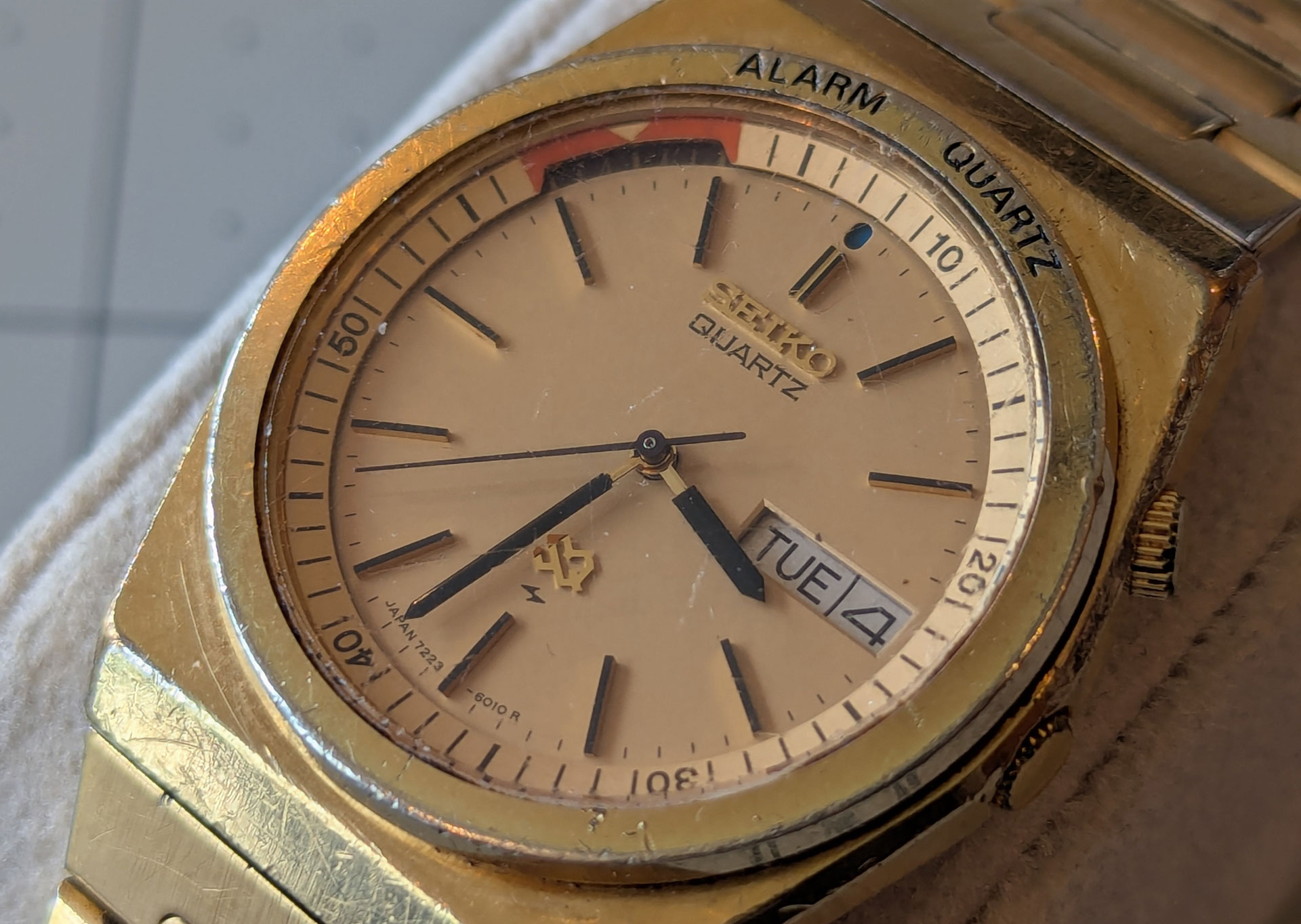
While the inner-rotating bezel, case, bracelet, and clasp give this watch the appearance of a dive watch, it most certainly isn't. It has no lume5 on any of the hands or indices and the caseback simply claims to be “water resistant” without specifying any depth rating. The two push-pull crowns6 and the holes in the caseback to allow the alarm sound to escape, combined with the fact that the gaskets on mine have largely degraded (I should replace them), mean that I'm hesitant to allow it near any water at all.
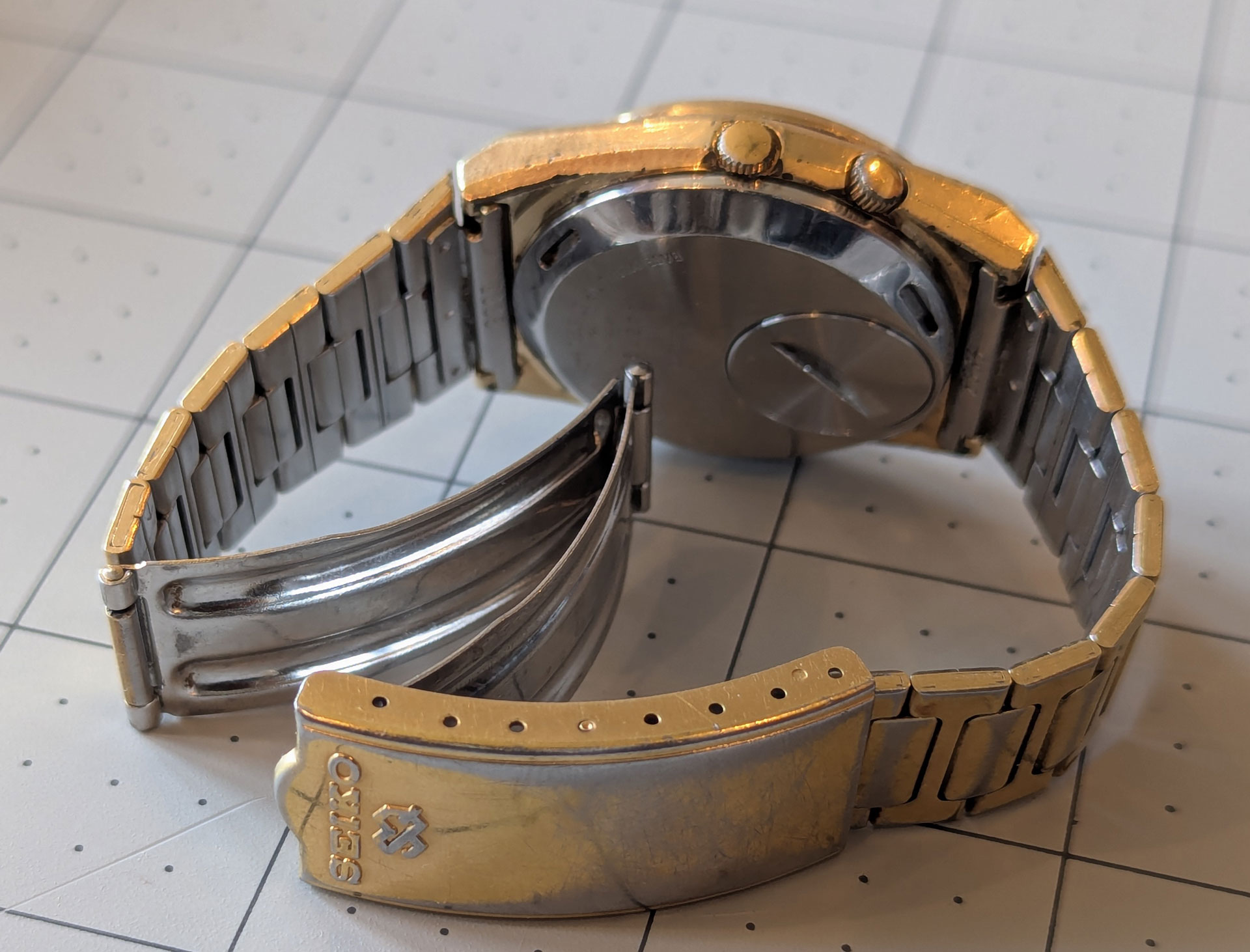
The build quality of the Alarm Quartz seems fairly standard for the era. It's certainly not poorly made but it doesn't have the craftsmanship or materials of an expensive watch. Overall, the watch seems to lack the premium feel of the Dolce line, but it's hard to say if that's because it's not as nice of a watch or simply due to the condition that mine is in. I'm guessing it's a mix of the two. Either way, its crystal is not sapphire and the bracelet is rather unpleasant by modern standards with jangly hair-pulling folded links. The clasp isn't great either, but I must commend it for having seven holes of micro-adjustment making it fairly easy to size without removing links. The stainless steel back is a snap-on style, but with a hatch that screws off easily using a coin for tool-free battery changes—a nice consideration given the alarm feature which no doubt consumes the life of a battery faster than a normal quartz watch. Another plus: the movement is quiet, accurate, and the second hand hits all the markers.
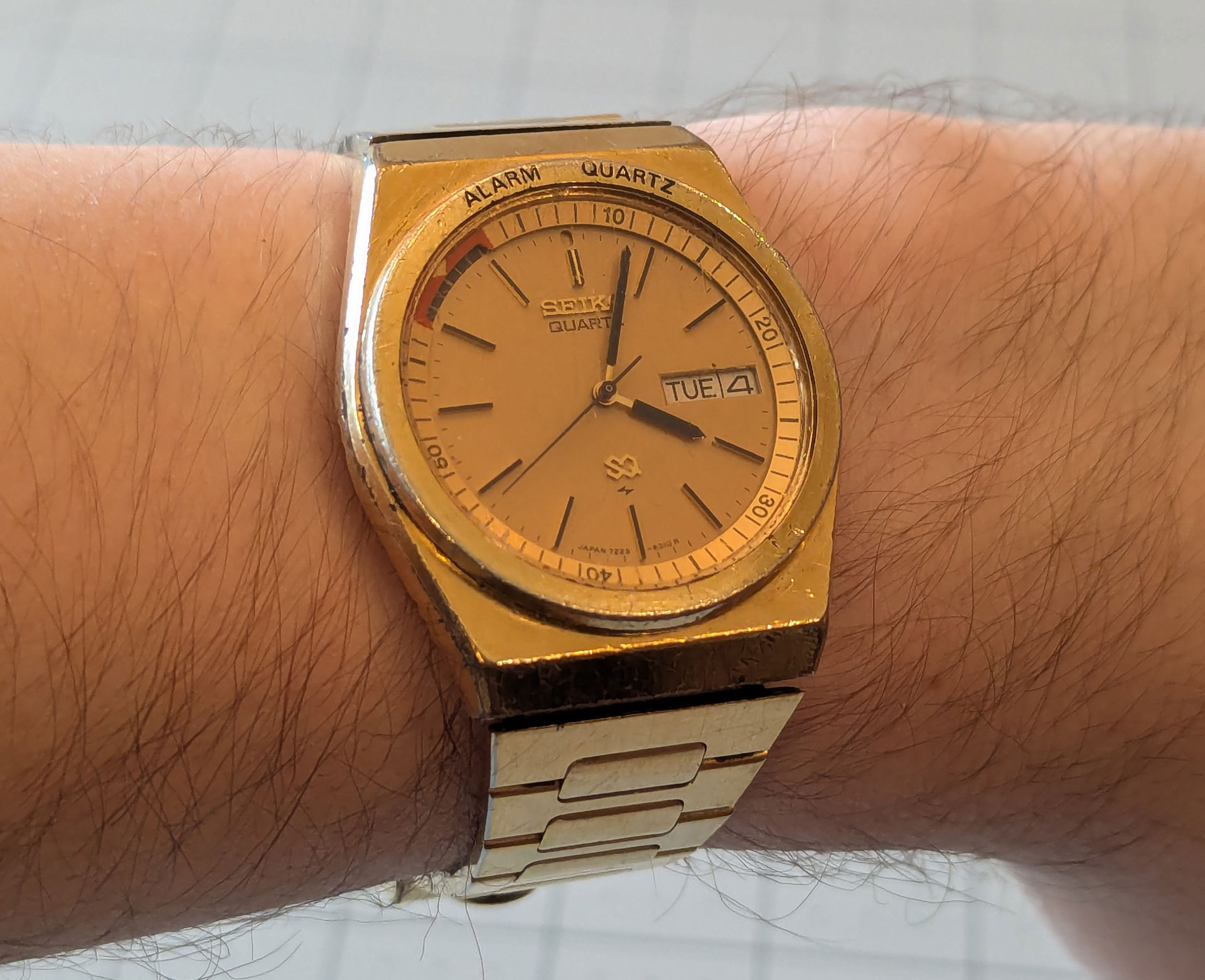
My final verdict on the Seiko Alarm Quartz is this: mine's in bad shape, but when I look past that, I see a very practical watch with timeless styling, an alarm feature that's kinder than most and integrated perfectly into the all-analog design, and unfortunately a few drawbacks that would doubtlessly frustrate me if I was wearing it every day.
As an aside, if you were drawn to this watch for the alarm but have spotted something that would bother you about it or don't like the idea of hunting for a vintage watch that may have condition issues like mine, I know a great modern alternative. If you absolutely must have an alarm in an analog watch that addresses nearly every flaw of the Alarm Quartz while including a number of additional useful features: the Casio LIW-M700D or any of the other Casio watches featuring the 5174 module is for you. Like the Seiko Alarm Quartz it has no digital display, just traditional hands. Unlike the vintage Seiko, it's solar powered, has lume, the alarm is a 24-hour selection meaning you don't have to re-enable it every night, and it has a stopwatch, countdown timer, world time, and syncs to a radio signal so you never have to set it.
5 Luminous material, i.e. very concentrated glow-in-the-dark coating to enable you to read it after dark. This is a requirement for diver's watches back
6 As opposed to crowns that screw down to ensure they are watertight back
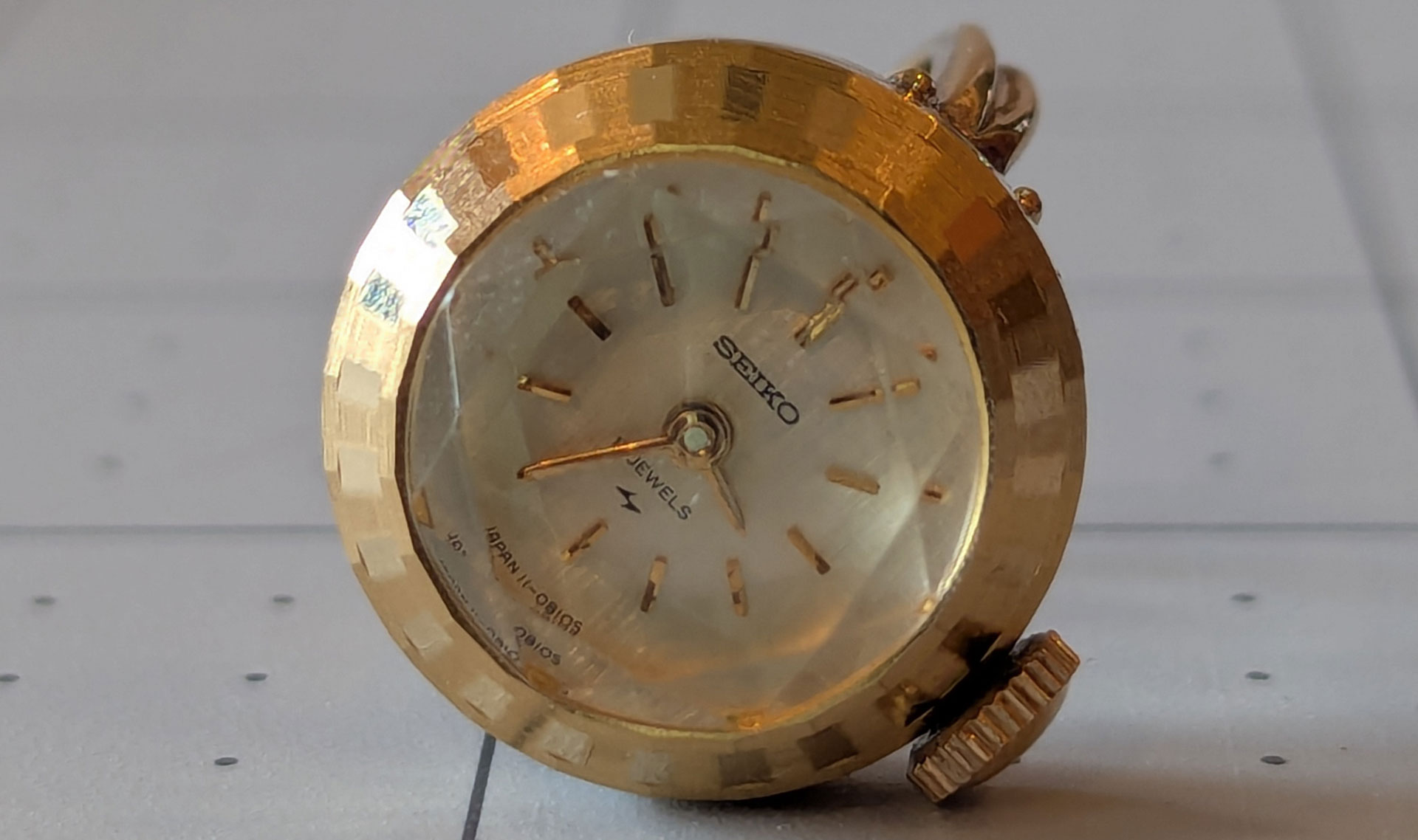
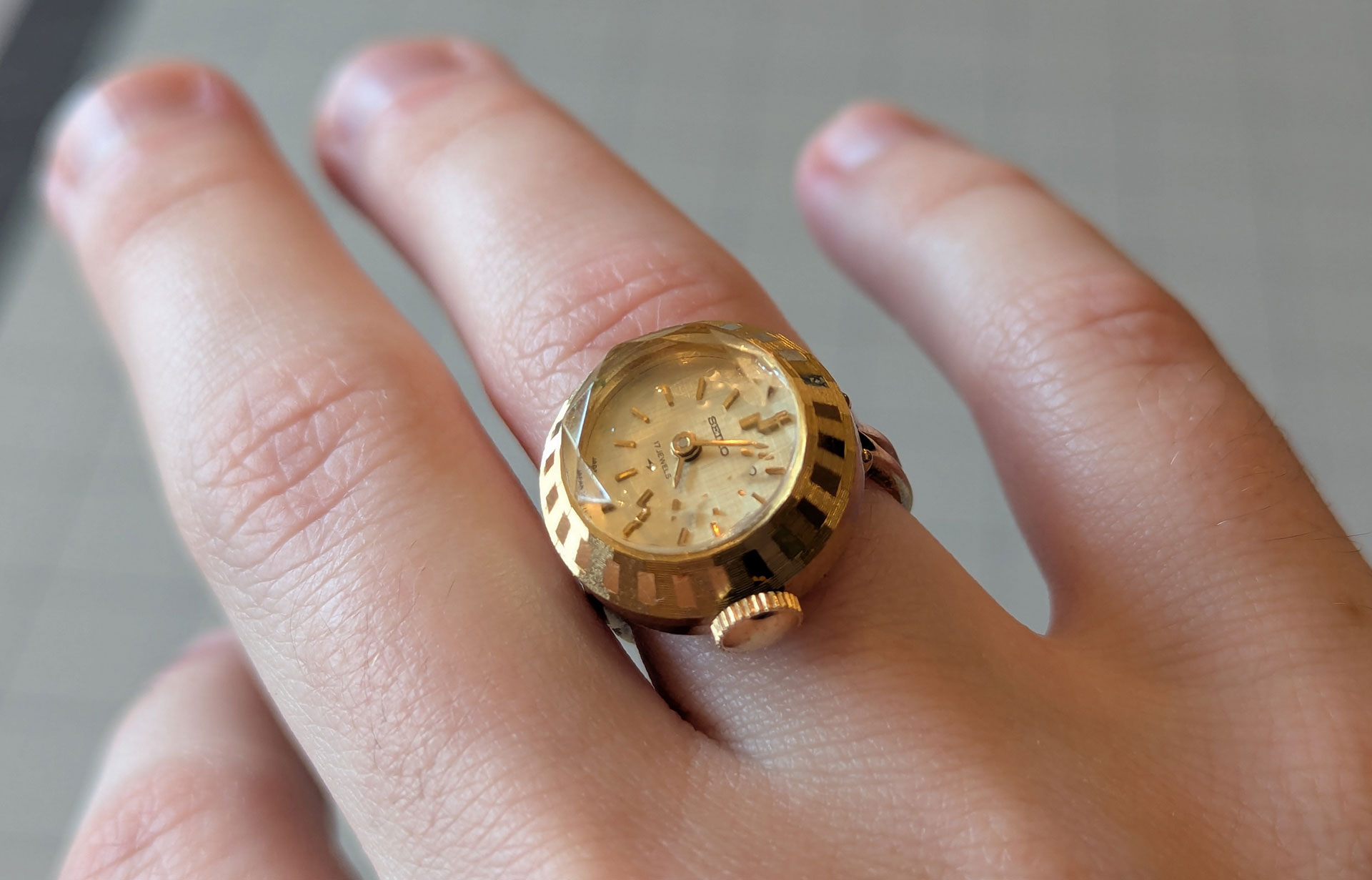
The last watch—if you could call it that—is a bit of a novelty item but is nonetheless a genuine Seiko product and made to the same standard as their other watches; it's just not quite as large. It's a ring watch! This is a fully-functional 2-hand mechanical watch built into a small case designed to be worn on the finger instead of the wrist. My best guess as to the manufacture date for this watch, based on the serial number, is September 1978. Information on these is sparse on the Web, but it's entirely possible it actually dates to 1968. Either way, it's the oldest watch I own, in addition to being the smallest.
Ring watches are somewhat in vogue again these days thanks to Casio reviving the idea with a line of petite incarnations of their square G-SHOCKs, but the idea is actually much older, as the existence of this Seiko demonstrates. Beyond the atypical case, there's actually not much notable about the Seiko ring watch. It uses the Seiko 11 movement which was used in a large number of ladies watches for decades. This watch's case and dial are really no smaller than many small women's watches either, it just happens to have a ring attached to it instead of a bracelet. Seiko made these rings for a long time, though I haven't been able to determine the exact span. They made them in several different shapes and colors, and even released a quartz variant eventually. But this version with the round, faceted crystal and polished rectangles around the edge, seems to be the most common one, though I found that they are most abundant in stainless steel with a blue dial as opposed to this gold version.
The hand-wound mechanical movement inside is fairly reliable despite its age. Mine seems to gain about a minute per day, which while not ideal, is probably fine for a watch that is unlikely to be worn regularly and has such a tiny dial. I considered attempting to regulate it, which I'd do with any other watch running this inaccurately, but ultimately I'm hesitant to open it. The case can be pried apart and opens down the middle to reveal the movement, but with such a small case and the nature of the gold coating, I'd worry about scratching it. Beyond the slight inaccuracy, which is probably still within spec for this movement, the watch will happily tick away for more than a day on a full wind. I couldn't find any official documentation on what the power reserve should be, but my guess is about 35 hours. This tiny movement with its tiny mainspring doesn't take a lot of winding, either—it seems to take only 10 full rotations to get it fully wound from dead. That's impressive to me for some reason, I guess because I'm used to larger men's watch movements that take a lot more work to get going. I'm glad I got the mechanical version of the ring watch, anyway, because there's something magical about holding this thing up to your ear to listen to it tick. Being about the size of an earbud, it's hard to resist.
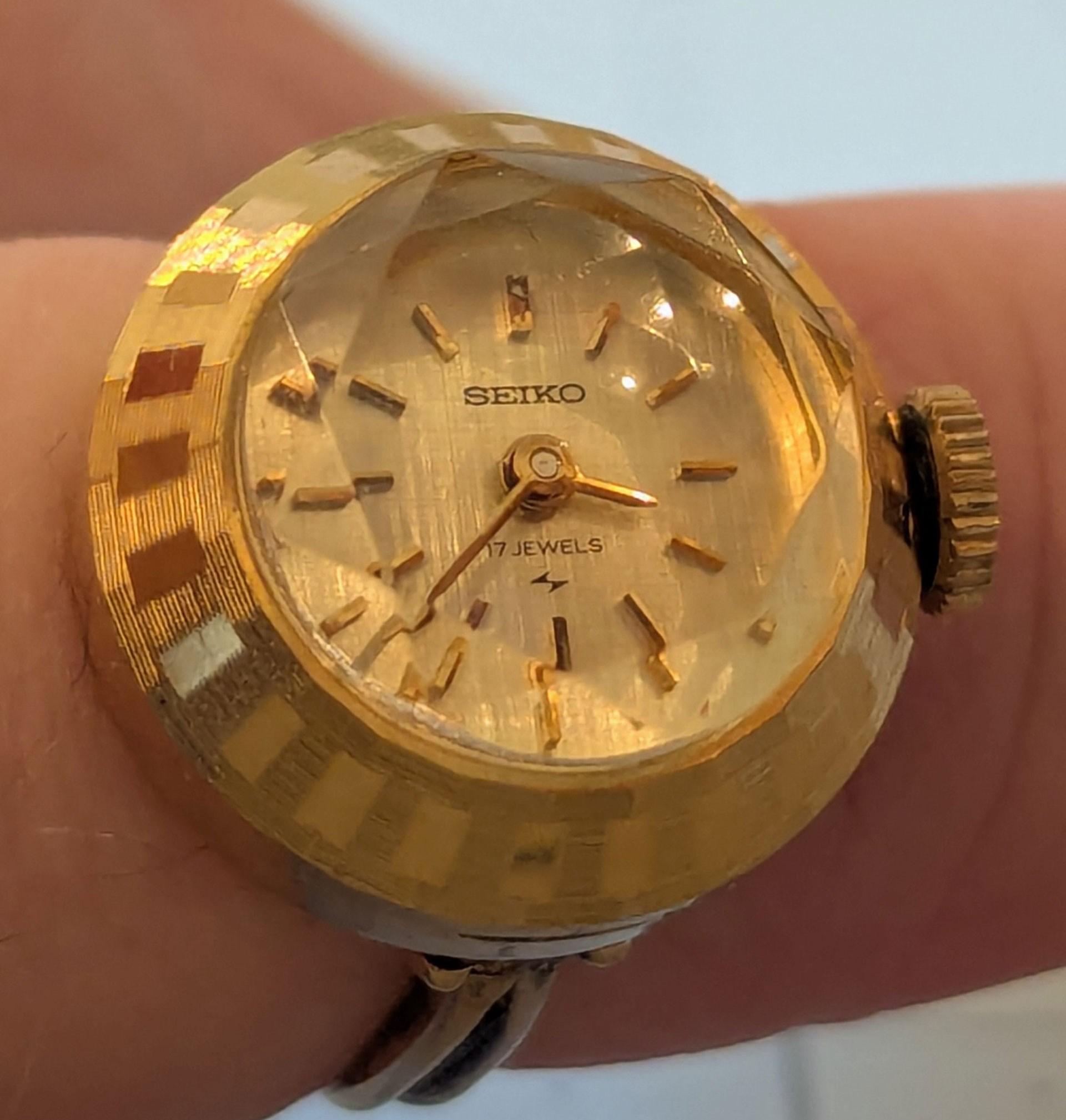
As there's not much of this watch, there's not much to say about its build quality. The dial is simple because it's quite small, but nevertheless has a subtle grid pattern and applied indices. There's no minute track and the hands are as simple as they possibly could be: just two golden sticks that come to a point. The case finishing is quite interesting with its gold-plated surface polished in this pattern of rectangles around the dial which reflects the light quite nicely. The ring part is designed to be resizable by bending the two arms to fit any finger. This design is nice because it enabled me to get a good fit, but the small gap between the two sides of the rings means I sometimes get a bit of a pinch while taking it off, which I have to do quite frequently when I wear it; the fatal flaw of the Seiko ring watch is that it seems to have no appreciable water resistance, meaning the wearer should remove it any time they wash their hands. At least, there's no water resistance rating stamped in the caseback and I couldn't find any information online to suggest it's built to withstand hand washing. So, I'm opting to be cautious.
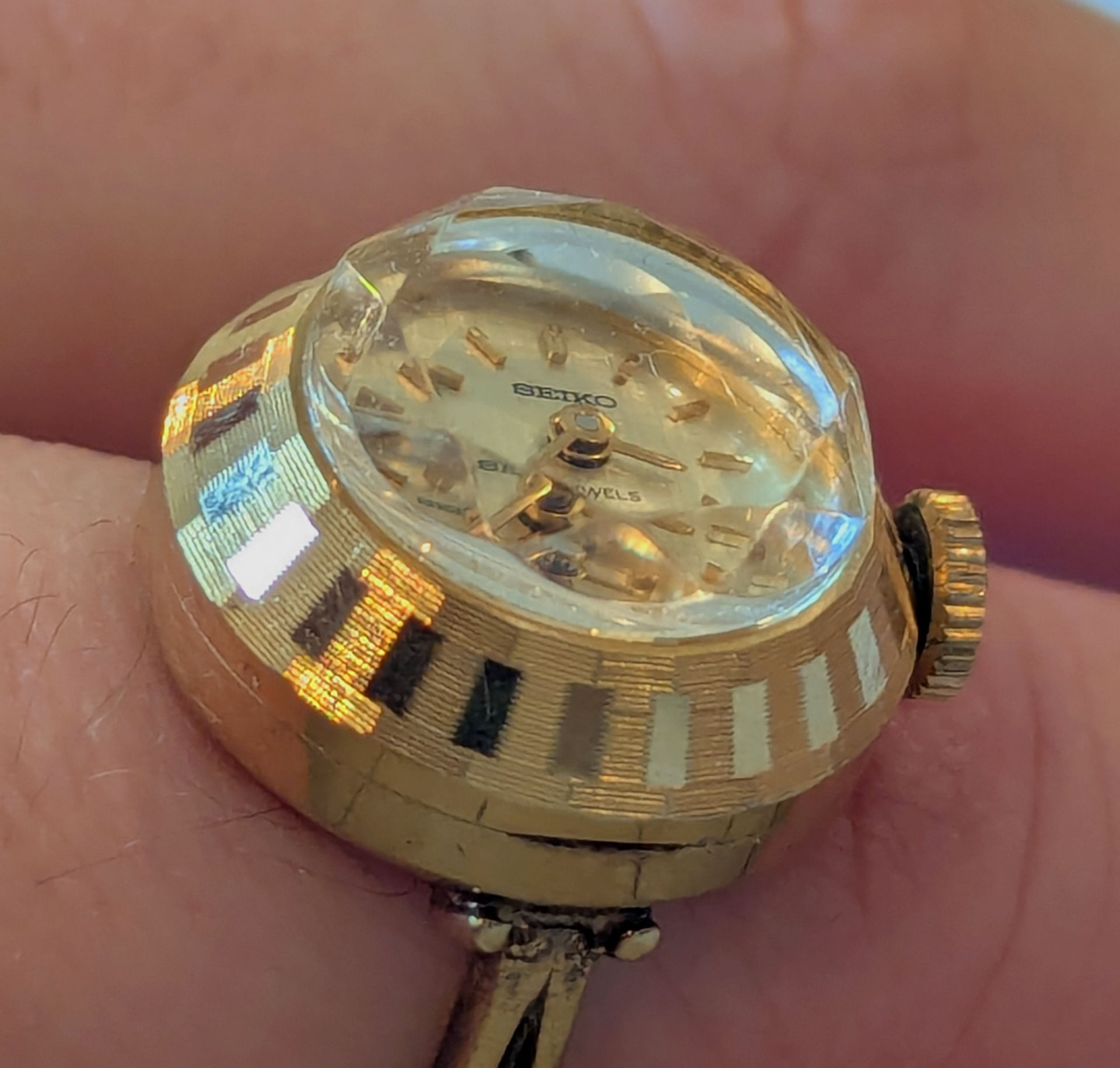
Another aspect of the ring watch that bears treating cautiously: it's very thick and therefore protrudes considerably from your finger and is liable to catch on things if you aren't careful. Presumably to give the appearance of a large gemstone, Seiko chose to put a very tall crystal over the dial that adds unnecessary height. That crystal is also just acrylic which is disappointing as it would gather scratches quite quickly if worn regularly. Luckily mine is in like-new condition, no doubt because its previous owner realized how silly it looks and never wore it.
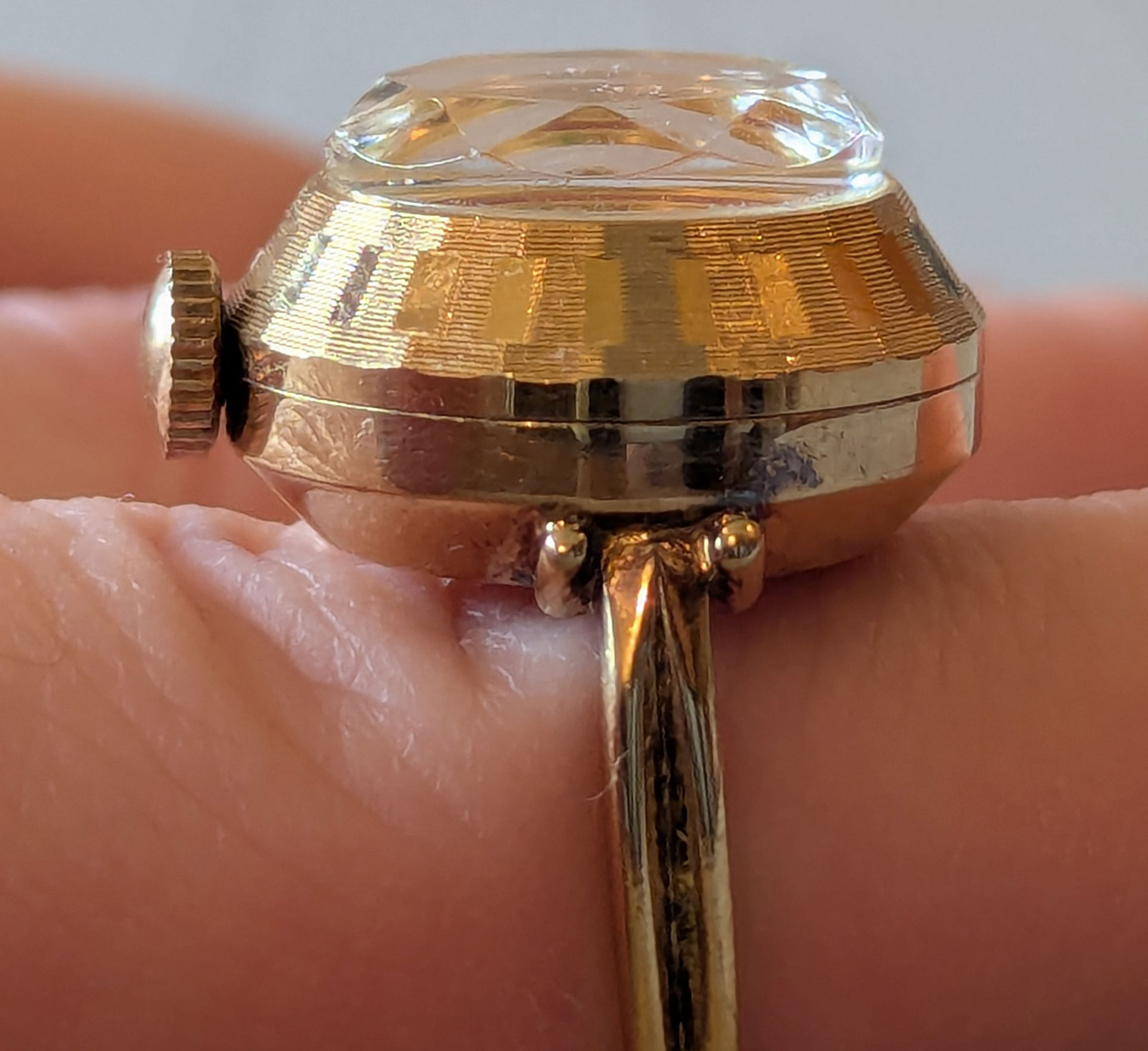
That's about all there is to say about the Seiko Ring Watch 11-0290. There isn't much to recommend it on its own merits. It's not accurate, it's tiny and hard to read, makes you look like Liberace, it will inevitably bump into something and scratch the delicate crystal, and needs to be taken off every time you wash your hands. So why did I buy it, then? Well, because despite its many obvious flaws as a serious timepiece, in my opinion, the Ring Watch's gimmick is just so silly and over the top that it's undeniably fun. It's so uncool that it wraps around to being cool again. You just can't argue with the novelty factor. Some collectors are primarily concerned with getting watches that “look good” or that fall within some well-defined personal preferences, and I can respect that. In many regards, that's the better way of doing things. But I know myself well enough to know that a little bit of novelty goes a long way in my heart, and as much as I love a watch that is high quality or pairs well with the way that I dress, the biggest factor that draws me towards a new watch is being different from anything else I have in my collection. One thing you can say about the Seiko Ring Watch, is that it's certainly different. And if that's not enough for you, well, at least it doesn't take up very much space.