 Back
Back
Published 2026.05.11
As per my promise in the previous article—quite a dry one about watch collecting wherein I avowed that my next post would have nothing to do with watches—here's something that ought to be sufficiently left-field for you: Horse Cards.
Longtime readers may recall WizPriz, the card game/zine/album I put out a couple years ago. The concept behind WizPriz was that I had a dream in which the rules of a card game were conveyed to me with remarkable clarity. In the dream, I was playing a card game, and miraculously when I awoke, not only did I remember the rules, but they were also (to my knowledge) wholly original (that is to say, not a copy of an existing game) and somewhat coherent. I wrote them down right away and tested it not long after; luckily, WizPriz is playable using only standard playing cards. Was it fun? No, not really.
It essentially boils down to luck. There's very little strategy, and the hardest part of the game is remembering and evaluating the rules correctly. I tested the game and made some very slight alterations to improve the experience—largely additions, without changing or removing any elements of the original game—and ultimately got it to a place where you could play it and perhaps have a bit of fun, even if it still wasn't particularly stimulating in the decisionmaking department. The enjoyment of WizPriz is largely dependent on how much you engross yourself in the theme of the game; its novelty is derived from the fact that each player is assigned a role in a fantasy kingdom and the cards represent different wizards.
I bring this up because ever since I invented WizPriz, I've been attentive to the possibility that it could happen again; that another dream could bring me a fully realized game idea. Recently, it did! But dreams are rarely what you expect. The game I was playing in my most recent dream, while equal in the lucid detail in which it was presented to me and recalled upon waking, is quite a bit different than WizPriz. It is not as simple to reproduce, and as a result, I haven't really played it (yet) in the precise form of the dream, but I suspect that if properly implemented, it could be a good deal more fun than WizPriz.
The new game is called Horse Cards.
I shall now attempt to explain the context in which Horse Cards was being played in the dream that I had.
I was at some kind of late-night gathering at a friend's house with a group of unspecified size. Don't ask me who was there, I don't remember. Four players were gathered in front of a television playing some kind of party game. I was not one of them. Instead, I was seated on the fringe of this group, sleepy as all get-out, struggling to stay awake. I had no interest in games. But before I knew it, I was handed a controller. One of the four players had gotten up to go to the bathroom or something, and I was asked to sit in for a round. In my barely-conscious state, I hadn't been able to refuse, so I was thrown into this game.
It wasn't a standalone thing, it was one of a collection of mini games. Something of a mix of the competitive aspect of Mario Party, with the pacing of WarioWare, and the social/humor aspect of Jackbox Games. I only played for one round, though. I only played Horse Cards.
I shall now attempt to describe, to the best of my ability, how Horse Cards works from the experience in my dream.
Four players, each with their own controller, are seated around a single screen divided into four quadrants (that is to say, conventional split-screen). The round begins. A timer starts, and cards are displayed on the screen.
Each of the players' quadrants is further divided in half and then in half again, into four vertical slices. Each slice is a card. In each half of the player's view, one of the two cards is highlighted. The left thumb stick switches which card is highlighted on the left (red), while the right stick switches which card is highlighted on the right (blue).
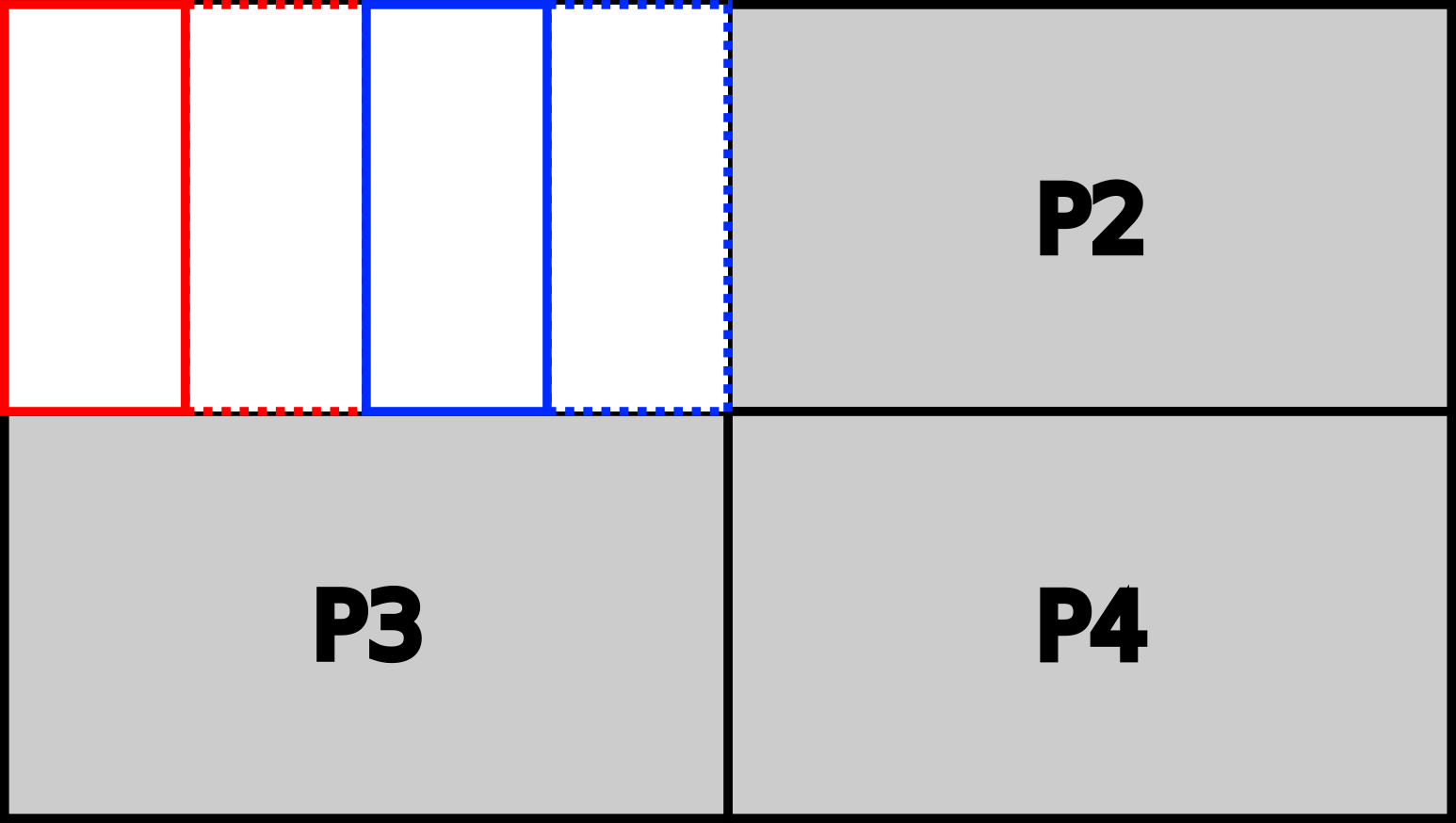
An approximation of how the screen looked in Horse Cards from the first player's perspective. Other players' screens are grayed out for simplicity.
The player has approximately ten seconds to read the cards and select one card out of each of the pairs. Note that you're making two separate choices: you cannot pick both left cards, for example. You must pick one from the left and one from the right. There is no button to press to select a card, the card you select is simply the one highlighted when the time is up.
The cards themselves are randomly generated. Each card has:
The horse pictures are all different: some are photographs, some are paintings, some are illustrations. The perspective of each different image is at a different distance and angle relative to the horse. The horses are in different poses and situations. Some of the horses aren't even real, they're like, statues of horses. Sometimes there are non-horse objects in the pictures, but there is always at least one horse. Basically, it's like if you googled “horse” and picked one of the resultant images at random.
The captions aren't inherently horse-related. They're maybe one to fifteen words long. Some of them are funny, but they're not jokes. There is no prior stage at which humans in the group entered these captions; they are selected from a large list of pre-written captions. Just a random grouping of words, basically, though all of them are real words that have some intelligible meaning.
The result is a random card with a horse and some words on it. Sometimes funny, sometimes surreal, with no meaning or intention behind it. These are the horse cards.
So, which cards should you choose and which should you skip? Well, the game leaves that up to you. I guess, the one you like better. Or is funniest. Or whatever your heart tells you to pick. At any rate, everyone chooses a card, and that's the end of round one.
Then, all the cards are shuffled around. It wasn't clear in the dream how this worked, but if I had to guess, I would say it creates 8 new pairs of cards, each with one of the cards that was picked, and one of the cards that wasn't picked, ensuring no player gets a card they've already seen. The result is that you have a new set of four cards, out of which you must once again choose two (within the same span of approximately ten seconds).
Following round two, the cards are displayed one by one to the group in rapid-succession and the points are totaled. Each one is on screen long enough to read aloud, but no longer (as an editorial aside, I would not implement the game this way—it seems cruel to yank away the cards before you have a chance to really think about them). Every time two players agreed (that is, both voted for a card, or both voted against a card) they score a point. If two players had differing opinions, neither scores a point.
Technically, I suppose that makes the ultimate goal of Horse Cards not to pick the best horses, but to pick the same horses as everyone else. Or rather, to predict which horses will be winners, and which will be losers. Players cursed with a polarizing horse will lose, while those graced with an obvious favorite will win. Much like my previous dream game, then, Horse Cards is very likely dictated more by luck than by skill.
Without any insight into the broader structure of the game containing Horse Cards, I can't say what the points really mean. It's possible that the points go towards a larger total, and therefore ties are of no consequence. But if it's just to determine who is the winner of Horse Cards by itself, I imagine ties would be quite frequent. Perhaps it could be extended to multiple games with 16 new cards.
Beyond the minutiae of the gameplay, one has to wonder: where did this dream come from? What is the origin of this strange idea? Though this be madness, yet there is method in 't. I can't be sure, but I think it must relate to horse racing. Racehorses often have nonsensical names, and choosing one of them that you think will be a winner is a central aspect of the sport. So, while the game's concept does seem at first to be arbitrary, there is a fairly firm connection to reality. Regardless of the meaning or origin of the idea that was planted in my head, I hope that the result proves entertaining.
I shall now attempt to create a reasonable approximation of Horse Cards to accompany this post, but it won't be exactly as it was in my dream.
The crux of the issue with perfect replication of the in-dream experience is twofold:
The images were sourced from various public domain sources (The Public Domain Image Archive, The Library of Congress, and Wikimedia Commons). As a result, they are in a variety of styles (as per the dream). After finding a goodly sum of public domain horses, I then cropped the photos to a uniform size and aspect ratio. The captions I either wrote myself, clipped from Wikipedia, or got from friends and family. I admit that neither dataset is as large as I would have liked, but I'm trying to limit the scope of this, because it's essentially a throwaway project.
The code works by randomly getting a horse picture and a caption, creating a canvas with both items drawn on top of a card base, then ultimately creating a picture from the result. This enables the user to download horse cards to their machine like they would any other image, while constructing them dynamically. I also created a variety of card base backgrounds to add some more visual differences to the different cards, though I can't recall if they were like that in my dream or not.
I'm happy with the results; they're very close to what was in my dream and I find them sufficiently amusing.
I'm offering two ways to experience Horse Cards: