 Back
Back
Published 2026.05.29
Recently, while in a half-conscious state, at the border between sleep and wakefulness, I had a striking dream or vision. Unlike Horse Cards or WizPriz, this dream was not a game, but rather a design for a watch mechanism. The idea was simple, seemingly quite feasible. It's a new complication that no watch has ever included to my knowledge, yet in my subjective opinion, it is simple, useful, intuitive, and aesthetically pleasing. It could be added to any watch with a three-hand movement, because it does not interact with the movement whatsoever. I actually got up out of bed to write this down, along with some illustrations, because I thought this idea was so good.
The concept is simple. It's a bit like an inner-rotating bezel, as featured on the Seiko Alpinist or on compressor-style dive watches like the Longines Legend. These watches use a second crown to control the position of a ring around the face of the watch, allowing you to track some information on the hands. Usually, this will be a dive bezel, which come in "count up" and "count down" varieties. My watch design features something quite similar, only instead of a single rotating ring around the outside of the watch, my design's crown controls two semi-circular "shutters" that are sandwiched between an inner dial and an outer dial. The inner dial has a second track of hour and minute markers, which can be selectively obscured by the wearer to highlight any angular segment of the dial up to 180 degrees (30 minutes or 6 hours, that is) by controlling the position and overlap of the two shutters. The system would be connected to the crown such that when the crown is fully pressed in, the shutters are locked, but popping out the crown to the the first position adjusts just one of the shutters (controlling the length of the segment, or the overlap of the shutters, however you choose to view it), while the second position of the crown controls both shutters together (adjusting the position of the highlighted segment).
Here are some profile diagrams showing very roughly how this might work. Of course, in reality, the mechanism would probably work quite differently, but this illustrates how everything might overlap and what the crown positions are.
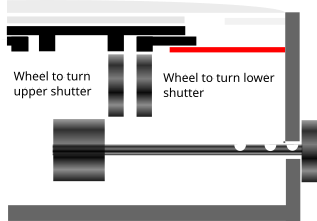
The crown fully pressed in, it doesn't engage with either shutter.
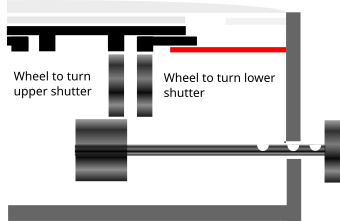
The crown popped out to the first position, it engages with only one shutter.
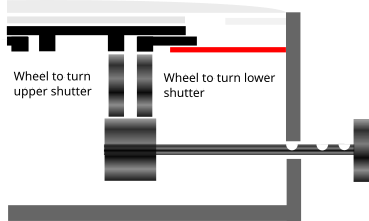
The crown popped out to the second position, it engages with both shutters.
The result is a very interesting mechanism that has a lot of potential for timekeeping utility. Like most dreams, it's possible to analyze its meaning and where it came from. I can think of two major inspirations for this idea, concepts that have spent a lot of time idly floating around my mind. Firstly, it's sort of like a slide rule in how you move two pieces to express a distance or ratio, then move them and read them off a scale. I semi-recently got slightly obsessed with analog computing devices like that, and that's certainly got to be a contributing factor. The second inspiration is likely the Seiko Alarm Quartz that I reviewed in this blog post. It also has a unique mechanism for tracking time using an inner rotating ring, only its ring is used to set an alarm time that goes off when the hour hand reaches the specified point. But it's graded for general time-measuring, too! So, my unconscious mind can't take all the credit for this brilliance. If I have seen further, it is by standing on the shoulders of slide-rule-and-watch-designing giants.
The practical applications of such a system are innumerable. Here are a few options.
Firstly, you could use it as a sort of count-up dive time bezel for timing things. Simply line up the start of the highlighted region with the current time, wait for the thing you're timing to be done, then align the end of the highlighted region to the current time. It may at that point be obvious the length of the highlighted period (depending how long it is), but if you'd like, you can subsequently move the entire highlighted region back to the origin and read it on the outer scale.
You can also use it as a count-down dive time bezel. Start with the region beginning at the origin and move the end point until it's at the time you want. So, to set a 15 minute timer, you'd move the lower shutter such that the opening through both shutters is from 0-15 minutes. Then, move the highlighted region to align the with the current time.
Something this design can do that a standard dive time bezel cannot: track some period of time in the past or future. Say you have a meeting from 3 to 4, and it's only noon. If you want to remind yourself of that meeting, line up the highlighted region with the 3 and 4 o'clock hour markers, and now you have a visual representation of when your meeting is. Or, say you started a movie at 9 PM and you checked the runtime after it started and it's 2.5 hours long. Create a 2.5 hour highlight, then move it to 9. Now you have a progress meter for your movie and you know when it'll be over.
This may sound complicated, but it is really intuitive once you work with the mechanism a bit. There's something sort of odd about the two rotating shutters, in that sometimes you are adjusting the beginning of the region, and sometimes you are adjusting the end, but this can be to your benefit once you develop a feel for the system.
One limitation I see is that it can only time things up to 6 hours or 30 minutes, on each respective hand. I've attempted to mitigate that by considering adding a couple additional shutter options. The shutters could be graded on the outside to allow an alternative arc to measure against which can go from 180 to 360 degrees. This would require precise alignment, and ideally would have a mechanism to click the shutters into 60 pre-aligned positions.
Sometimes, I get a little over-excited about ideas. When I first had this dream, I woke up feeling like I should patent it and/or start a watch microbrand and get this watch built... but, patenting something costs a small fortune, as does starting a business and designing/producing a watch, and while I think this is a great idea still even after thinking about it for a while, I don't know that it's really a marketable idea, especially by someone with no experience running a business. And the truth is, while I know a lot about watches, I don't know everything, so I'm really not positive this is an original idea. If you know of an existing watch with a similar feature, let me know!
Anyway, I haven't patented this idea so any aspiring watchmakers who stumble on this blog are free to have a go at making it. I guess you can even sell it, though I'd hope you'd have the decency to send one my way if you do.
I am not an engineer, or at least not the kind of engineer that can build complex mechanisms. Furthermore, I don't really have a completely solid idea of how the gearing of the mechanism would work in reality. But I can do the next best thing and have an interactive simulation of the idea built into this post. So I did!
This is a web-based simulation of my watch concept.
It shows the user's system time by default, but the time can be adjusted however you like using the lower crown. Pull out the lower crown using the green arrow button, which stops/hacks the movement, at which point you can adjust the minutes (fine control) via the inner green arrows, and the hours (coarse control) via the outer red arrows. Likewise, the shutters can be operated with the upper crown. Pull out the crown one level to adjust just the lower shutter, and another level to adjust the upper and lower levels simultaneously. Click and hold on the arrows of the upper crown to rotate the shutters. You can also operate the watch using the left and right arrows, which adjusts whichever control is active based on the crown state. Press the sync button at any point to resume timekeeping from the current time.
You can have the movement run in single ticks (like a quartz movement) or sweeping like a mechanical movement. Press the toggle button to make that change.
There are also a few different dials handsets to choose from, to show what this mechanism would look like in various styles. There is one handset which is my own design, specifically for this watch. I made the hour hand point right to the markers on the inner dial, and made the minute hand with a window allowing you to see the inner dial behind it and precisely track the minute hand's progression over it.
You can also change the shutters to different graded options: one black, one green (watermelon and kiwi mode, for contrast), and one grey. The graded shutters reveal some of the inaccuracy of my alignment, but are close enough to demonstrate what that might be like.
The watch will load by default with a random dial, shutter, and set of matching hands. From there, you can customize it as you'd like.
I added a button to change between different numbers of clicks/detents in the shutter rotation. By default this is 60 so the minute markers always line up. But you can switch to 120 for finer control or a totally smooth option. On the clicky settings, there is a click sound effect which can be muted if you want.
I went a bit crazy and gave the user control over dial colors too, just for fun, as well as the option to make the dial solid if you just want to have a plain 3-hand watch.
Lastly there is a layer control which shows/hides each of the various components. This is useful if you'd like to see how the rotors move behind the dial, or don't want a seconds hand, etc.